
What Is a PR Team? Definition, Roles, and Why You Need One

Last reviewed: March 2026
Justin Mauldin | Founder, Salient PR | Justin has built and structured PR teams across agency and client-side engagements, hiring and managing roles at every level of the hierarchy covered in this guide.
What is a PR team, and what does the term actually mean for your business? Understanding the pr team meaning starts here: A PR team (public relations team) is a group of communications professionals who manage an organization's reputation, media relationships, and public messaging. PR stands for Public Relations — a PR team is the department or agency team responsible for shaping how the public, media, and stakeholders perceive your brand. When people search "what is a pr team," that is the answer they need.
By engaging with media, crafting brand messages, and handling public relations crises, a PR team is essential in shaping the narrative around your business. Their strategic efforts ensure that the company's voice is heard and respected in a crowded marketplace. This article will dive into the roles and importance of a PR team, offering insights on how they contribute to a business's success.
Key Takeaways
PR teams are critical for managing a company’s public image, handling media relations, driving brand awareness, and are essential during crisis management to protect and restore reputation.
The structure and makeup of an effective PR team depend on company size, campaign scope, and resources, with essential skills including communication, creativity, and media relations expertise, and can involve a mix of in-house and external agencies.
Monitoring and measuring the success of PR efforts is crucial, involving the use of KPIs, data analytics, and media monitoring tools to assess impact and inform strategic decisions, with growth and expansion considered as workload and campaign needs increase.
The Essence of a PR Team
A PR team is responsible for:
Shaping public perception
Leveraging unpaid or earned media to establish positive connections with the public
Influencing both external and internal communications
Using storytelling prowess to create and distribute engaging content
Turning a brand into a household name
Driving sales and increasing brand awareness.
The PR team’s main tasks include:
Fostering positive brand perceptions
Impacting various facets such as employment, sales, credibility, and customer loyalty
Guiding the brand’s reputation
Playing a key role in media coordination and relationship building, especially in this digital age.
Key Responsibilities
From crafting compelling brand messages to managing crises, the public relations team juggles an array of responsibilities. They skillfully develop communication strategies, disseminating the essence of the brand through various channels such as blogs, press releases, and social media posts. But their role is not just about spreading positive messages; when something goes wrong, publicists become invaluable assets in minimizing damage and restoring reputation through effective communication plans and preparation.
Media outreach is another critical aspect of a PR team’s role. This involves creating brand messaging, engaging with journalists and influencers, and participating in networking events. These activities help establish relationships that generate favorable media coverage, further cementing the brand’s positive image.
What Does a PR Team Do?
Understanding what a PR team does goes beyond a simple definition. PR team work spans multiple disciplines, each serving a distinct function in how a brand communicates with the world.
Media Relations A PR team pitches stories to journalists, writes and distributes press releases, and maintains ongoing relationships with reporters, editors, and producers. The goal is earned media coverage — placements your brand did not pay for.
Crisis Communications When something goes wrong, the PR team leads the response. This includes drafting holding statements, coordinating rapid response messaging, advising leadership on public-facing communication, and managing the fallout to protect the brand's reputation.
Content Creation PR teams produce press releases, executive bylines, thought leadership articles, and media kits. This content supports both media outreach and broader brand positioning.
Brand Reputation Management Monitoring how the public perceives the brand is ongoing PR team work. This includes tracking media sentiment, responding to negative coverage, and proactively building positive narratives.
Event PR and Launch Campaigns From product launches to press events and trade shows, PR teams manage media attendance, coordinate announcements, and maximize coverage around key moments.
Internal Communications PR teams often support internal messaging, ensuring employees receive consistent, accurate information during company changes, leadership transitions, or crises.
Social Media PR Strategy PR teams shape the brand's public voice on social platforms, manage reputation-related responses, and coordinate with marketing on messaging consistency.
PR Team Roles and Members
A PR team's structure varies by company size, but the core PR team roles remain consistent across organizations. Here is a breakdown of the standard hierarchy and what each position owns.
Chief Communications Officer (CCO) / VP of Communications The CCO or VP of Communications sits at the top of the PR team hierarchy and reports directly to the executive team. This role sets the overarching communications strategy, manages brand reputation at the highest level, and serves as the executive voice during major crises or announcements.
PR Director / Account Director The PR Director translates executive strategy into actionable campaigns and oversees the day-to-day management of the PR team. In agency settings, an Account Director manages client relationships and is accountable for campaign performance and delivery.
PR Manager / Account Manager PR Managers coordinate campaigns, manage timelines, and serve as the primary point of contact between senior leadership and junior staff. They ensure that deliverables are on track, messaging is consistent, and team members have clear direction.
PR Specialist / Account Executive This is typically the core execution role on a PR team. PR Specialists pitch journalists, draft press releases, build media lists, and handle the day-to-day outreach that drives coverage.
Media Relations Specialist Focused exclusively on journalist and media relationships, a Media Relations Specialist maintains a network of press contacts, monitors editorial calendars, and identifies placement opportunities. This role is especially valuable for brands with high-volume media outreach needs.
Content Strategist / Writer The Content Strategist or Writer produces the materials the PR team relies on: press releases, executive bylines, talking points, media kits, and thought leadership articles. Strong writing and the ability to adapt tone across audiences are the core requirements of this role.
Digital PR / Social Media Manager This role sits at the intersection of PR and digital marketing. A Digital PR or Social Media Manager manages the brand's public-facing social presence, supports online reputation management, and coordinates with the broader PR team on messaging consistency across platforms.
PR Coordinator / Assistant The PR Coordinator handles administrative and logistical support: scheduling, media list maintenance, coverage tracking, and research. This is typically an entry-level public relations team role and serves as the pipeline for developing future PR professionals.
PR Team Responsibilities
The full scope of PR team responsibilities includes all of the above, but the throughline is consistent: manage what the public knows, thinks, and feels about your brand — and do it proactively, not just reactively.
PR Agency Structure
The structure of a PR agency determines how quickly it moves, how it serves clients, and what kinds of work it can take on. Most agencies organize around one of two models: account teams or practice groups.
Account teams are the most common structure. Each team is assigned to a set of clients and handles all PR work for those clients end to end. A typical account team includes a Director or VP at the top, a Manager who runs day-to-day operations, and one or more Account Executives handling execution. When a client signs with an agency, they are assigned to a specific account team that becomes their primary point of contact.
Practice group structures are more common in larger, full-service agencies. Here, the agency organizes around specialty areas, such as technology PR, consumer PR, healthcare PR, or crisis communications. Client work is then staffed from the relevant practice group, sometimes pulling specialists from multiple groups for a single account.
Full-Service vs. Specialist PR Agencies
A full-service agency covers the entire PR spectrum, including media relations, crisis communications, digital PR, content, and sometimes paid media. They carry larger teams, broader media networks, and higher retainers. Specialist agencies focus on a single industry or function, such as B2B tech PR, food and beverage, or crisis communications only. They typically offer deeper relationships within a narrow vertical and faster ramp time for clients in that space.
The right choice depends on scope. Brands with diverse PR needs across multiple audiences typically benefit from a full-service agency. Brands in a specific, competitive industry often get more traction with a specialist.
PR Agency Hierarchy

Not every agency includes all seven levels. Smaller boutique agencies may operate with just a Director, Manager, and one or two Executives. The hierarchy expands as the agency grows and takes on more clients and campaign volume.
The Importance of PR Teams for Businesses
As custodians of a brand’s reputation, PR teams have the significant responsibility of supervising, protecting, molding, and remolding the brand’s public image. Their expertise in improving brand reputation is vital for any business seeking to maintain a positive presence in the market.
These PR experts contribute significantly to building trust among stakeholders and attracting new customers through strategic publicity and positive brand messaging.
In the event of reputation-damaging incidents, PR teams prove instrumental in handling responses and ensuring that the brand’s image is upheld or restored. Their role is invaluable, acting as the lifeline that can rescue a brand from the treacherous tide of negative publicity.
Building Your PR Dream Team
Assembling a PR dream team resembles creating a masterpiece, necessitating thoughtful consideration, accurate selection, and detailed construction. Choosing a public relations team structure involves considering factors such as company size, the scope of the PR campaign, and available resources.
These components can impact the most effective approach to building and managing a PR team. PR firms can range from boutique to full-service providers, each offering a unique blend of resources and expertise for specific campaigns.
Finding the right candidates is paramount. Seek those who possess the required skills and display a genuine passion for the company’s PR objectives. Embrace diversity within the team to foster creativity and drive innovation. To navigate the hiring process, consult with industry professionals, set clear expectations for roles, and establish competitive salaries within your PR team.
A well-balanced PR team combines in-house staff for everyday activities and external agencies for specialized tasks.
In-house vs. External Agency
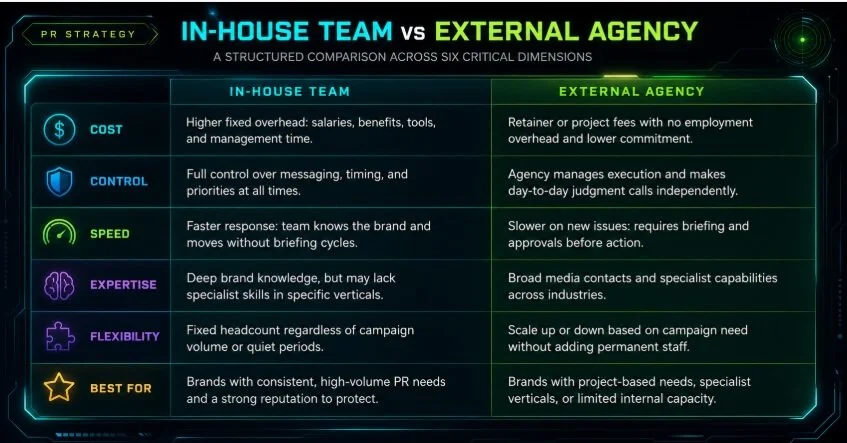
Deciding between an in-house team and an external agency is a pivotal choice when forming a public relations team. This choice depends on several factors, including cost, work volume, and the need for specialized skills.
An in-house PR team provides a deep understanding of the company, ensuring focused and company-specific public relations. However, they might struggle with a vast amount of work and lack certain specialized skills.
On the other hand, external PR agencies, including a specialized pr agency, offer broad industry expertise and extensive media networks, facilitating rapid dissemination of information. But there’s a catch. They might be costlier and have a less targeted approach due to multiple client obligations. The choice lies in finding a balance that meets the organization’s needs while maximizing the brand’s reputation.
In-House PR Team vs. PR Agency
The decision to build an in-house PR team or outsource public relations to an external PR agency is one of the most consequential choices a growing brand will make. There is no universal right answer. The right structure depends on your PR volume, budget, brand complexity, and how central communications is to your business model.
The hybrid model
Many established brands use a hybrid structure: a lean in-house team manages brand strategy, messaging, and always-on media relationships, while an external PR agency handles specialist campaigns, overflow volume, or verticals that require dedicated contacts. The in-house team owns the brief; the agency executes against it. This model captures the speed and brand knowledge of an internal team with the reach and specialist skills of an agency, without the full overhead of staffing for peak capacity.
Cost considerations
Building an in-house team requires budgeting for salaries across multiple roles, employer benefits, PR software and media monitoring tools, and ongoing training. A small but functional in-house team typically requires at minimum a PR Manager and a Specialist before it can operate independently. Agencies charge retainers that vary widely based on scope, agency size, and market, but the core advantage is that costs flex with your needs. A brand doing one product launch per year rarely needs a full-time PR team year-round. A brand running continuous earned media, crisis response, and content programs likely does.
Decision framework
Use this framework to identify which structure fits your current situation:
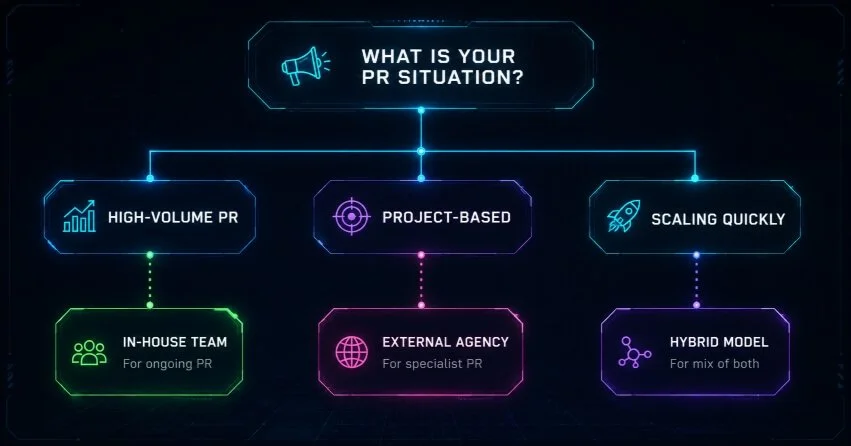
The decision is rarely permanent. Many companies start with an external agency to build early brand awareness and media relationships, then bring PR in-house once the volume and complexity justify the overhead.
How to Build a PR Team
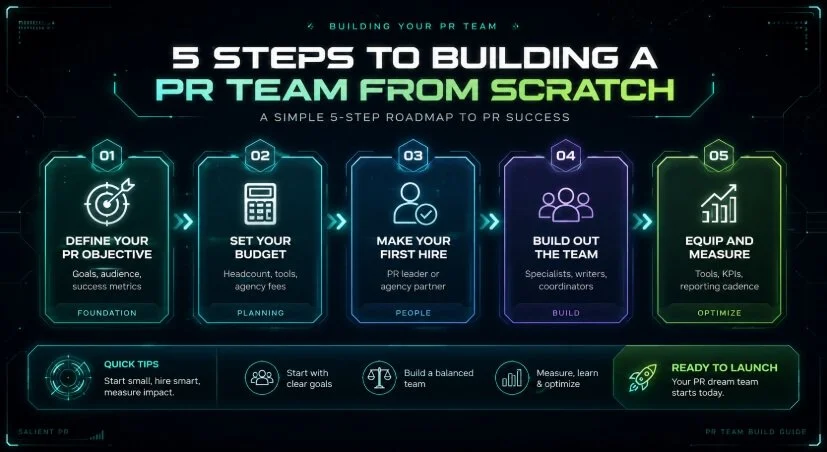
Knowing how to build a PR team from scratch is different from knowing what a PR team does. The roles and responsibilities are only useful once you have a structure to put them in. This section walks through the practical steps of assembling a PR team, whether you are a startup hiring your first communications professional or an enterprise formalizing a function that has been handled informally.
Which roles to hire first
The first hire sets the foundation for everything that follows, so it matters more than any subsequent hire. For most companies, the right first role is a PR Manager — someone senior enough to own strategy but hands-on enough to execute without support staff. Hiring a Director or VP first without execution capacity below them creates a bottleneck immediately. Hiring a Specialist or Executive first without someone to set strategy means the team operates tactically with no direction.
Once the PR Manager is in place and volume demands it, the next logical additions are a Specialist or Account Executive to handle media outreach and content production, and eventually a Coordinator to manage administrative load. Media Relations and Content roles come after that, once the team has enough campaign volume to justify the specialization.
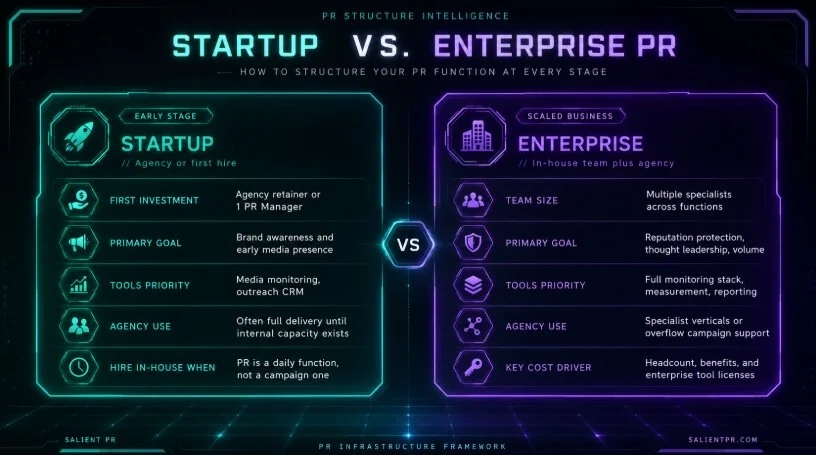
Budget considerations: startups vs. enterprise
The right investment level depends entirely on what you need PR to do and how central it is to your growth model.
When to supplement with agency support
Even a well-staffed in-house team has gaps. The most common trigger for bringing in agency support is a specialist need — a product launch in a vertical the internal team does not cover, a crisis requiring outside counsel, or a market expansion into a geography where the team has no existing media relationships. Agencies also absorb volume spikes during major announcements or campaigns where the internal team would otherwise be stretched past capacity.
The key to making the hybrid model work is clarity on who owns what. The in-house team should own the brief, the messaging, and the approval chain. The agency should own execution within those parameters. Ambiguity over who controls the narrative is the most common breakdown in hybrid structures.
Tools and technology a PR team needs
A PR team without the right tools is operating at a permanent disadvantage. Every function in the team's workflow has a corresponding tool category.
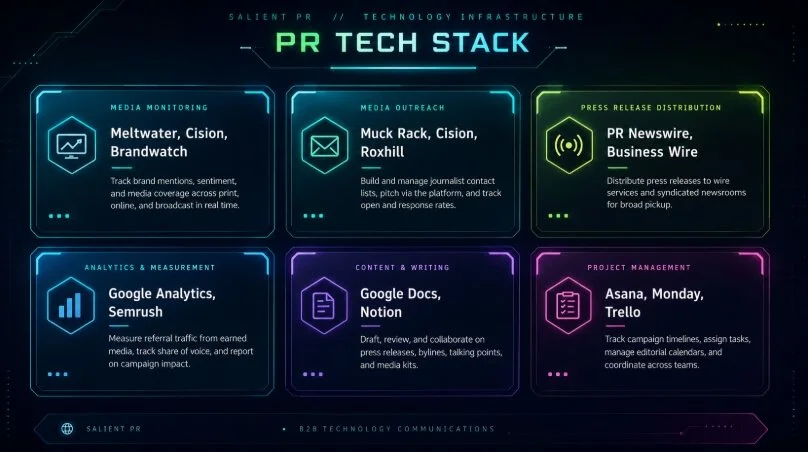
Not every team needs every tool from day one. A startup building its first PR function can cover most needs with a media monitoring tool, an outreach CRM, and a project management platform. The full stack becomes necessary as campaign volume grows and reporting requirements get more sophisticated.
Building a PR function from scratch involves more decisions than most companies anticipate. If you want a second opinion on structure, first hires, or where an agency fits in, schedule a consultation with Salient PR.
Essential Skills to Look For
A successful public relations team transcends a mere group of individuals; it’s a blend of skills, creativity, and enthusiasm. Here are some key qualities that make a PR team successful:
Exceptional communication skills for effectively sharing and crafting messages
Creativity to add the sparkle that makes messages irresistible
Dedication to public relations tasks and the ability to produce engaging content for different platforms
Media relations expertise, such as the ability to manage crises and create impactful content, is a must-have for a successful PR team. A diverse PR team may include roles like social media specialists, spokespersons, and publicists, each contributing to managing various aspects of public relations.
Not sure whether you need an in-house team, an external agency, or something in between? The answer depends on your stage, volume, and goals. Talk to Salient PR to figure out which structure fits your business.
Cultivating Collaboration and Growth
A thriving public relations team resembles a harmonious orchestra, where each member plays a distinct part, yet they all collaborate to produce a beautiful symphony. Enhancing collaboration within a PR team involves:
Implementing recognition programs
Incentive structures
Providing professional development opportunities
Fostering a culture of openness and constructive feedback
Collaboration in PR teams enables a greater exchange of ideas and insights, enhancing creativity and innovation.
To cultivate a growth-oriented mindset among PR professionals, it’s essential to offer professional development opportunities and acknowledge team members’ contributions. This approach is critical for ongoing improvement and adaptation to industry changes.
A collaborative culture within a PR team is essential to maintain a uniform brand strategy and effectively manage the company’s brand presence online, ensuring everyone is aligned with the brand’s vision.
Encouraging Teamwork and Open Communication
The most effective PR teams flourish through:
Teamwork
Transparent communication
Articulating expectations, timelines, and success criteria clearly
Using visual aids to make complex topics more accessible
Conflict resolution strategies
These practices can improve team dynamics and streamline work operations.
Building relationships outside of work can also improve team dynamics. Organizing company outings provides team members opportunities to bond and foster stronger relationships. And let’s not forget the importance of maintaining open lines of communication and alignment between the public relations team and the sales team.
This coordination facilitates the creation of relevant materials and ensures a consistent brand message. Being a part of a public relations society can also contribute to the professional growth of the PR team.
Training and Skill Development
Equipping PR teams with autonomy and appropriate tools is vital for their professional growth. Here are some ways to enhance their skills and knowledge:
Investing in workshops
Networking opportunities
Encouraging participation in industry conferences and mentorship programs
Exploring diverse learning mediums like webinars, podcasts, industry conferences, and online courses
By providing these resources, PR professionals can stay updated and improve their skills as a pr professional.
In the fast-paced world of PR, staying ahead of industry publications and trends is essential for continuous learning and skill enhancement. After all, a team that learns together, grows together.
Monitoring and Measuring Success
In the realm of PR, success transcends merely launching campaigns; it’s about gauging their effect. PR evaluation relies on data collection methods like surveys, media content analysis, and online metrics to determine how well PR objectives and goals have been met. Metrics such as:
the amount of media coverage
website traffic changes
brand sentiment
social media engagement
Utilizing market research in digital marketing analytics is crucial for analyzing the success of PR campaigns.
With the insights garnered from metrics and data analysis, PR teams can make informed strategic decisions to guide their future campaigns and efforts. In essence, what gets measured gets managed.
Establishing KPIs and Objectives
To accurately assess success, it’s essential to define Key Performance Indicators (KPIs) and set objectives for PR campaigns. Standard KPIs include:
Media mentions
Share of voice
Potential reach
Social media engagement
Sentiment analysis
Impressions
Website traffic
These KPIs should align with organizational goals and support the company’s overall mission.
Setting SMART (Specific, Measurable, Achievable, Relevant, Time-bound) goals for PR campaigns ensures they are focused and results-oriented. Measuring Return on Investment (ROI) for PR initiatives is essential to understand their cost-effectiveness and overall value. During the evaluation phase, establishing tailored metrics based on the goals of the PR campaign is crucial.
Utilizing Analytics and Data
Analytics tools like Google Analytics and social media analytics platforms are instrumental in evaluating PR campaigns. They provide valuable data on website traffic, press coverage, and brand awareness. Important website traffic metrics such as unique visitors, pageviews, bounce rate, and referral traffic can be measured using these tools to assess the impact of PR activities.
When assessing media coverage, focus should be on quality over quantity to understand the true impact of PR efforts. Media monitoring tools like Google Alerts and specialized software enable PR teams to efficiently track media mentions across various media outlets. Share of voice, a measure of a brand’s presence in the industry relative to competitors, acts as a valuable benchmark for PR success.
When to Scale Your PR Team
Recognizing the right time to expand a PR team can significantly transform a business. One clear indicator is when current members consistently report high levels of fatigue, risking burnout due to workload overload. Expanding the PR team becomes necessary when well-defined business goals and clear objectives require additional resources.
Intensified campaign monitoring requirements and the need for real-time strategy adjustments also call for a larger, more capable public relations team with media training.
Assessing Team Capacity and Workload
Evaluating the team’s capacity and workload is essential to discern when to enlarge your PR team. Implementing regular ‘capacity check’ meetings allows each team member to share their workload status and discuss current projects and challenges, fostering a proactive approach to capacity management.
Team capacity can be visually represented using scales, from 1–6, where lower numbers suggest availability and higher numbers indicate risk of burnout.
Setting reasonable expectations for PR work enhances ROI and ensures time is allocated effectively for both PR-related tasks and other essential business functions. After all, a well-managed team is a productive team.
Hiring New Members or Outsourcing
Once the workload exceeds the team’s capacity, it might be the right time to recruit new members or contemplate outsourcing. This decision depends on several variables, such as budget, relationships with media networks, the need for objectivity, and the potential for introducing new perspectives.
Determining the specific skills needed for successful PR campaigns is crucial in deciding if those skills are best obtained through hiring new in-house team members or outsourcing to external specialists.
A high workload reported by team members consistently may necessitate hiring new members or outsourcing to manage the team’s demands effectively. In the end, the goal is to ensure the PR team remains effective and efficient, capable of managing the brand’s reputation deftly.
Summary
In the intricate dance of public opinion, a well-structured, skilled, and collaborative PR team can choreograph a brand’s reputation to perfection. From managing media relations, crafting compelling brand messages, cultivating positive public perceptions, to monitoring and measuring success, a PR team is the backbone of a brand’s image.
Whether you’re building a dream team or scaling an existing one, always remember that a well-managed PR team is the lifeline that can navigate your brand through the turbulent waters of public opinion to the safe shores of success.
Curious to learn more about how Salient PR can elevate your public relations? Visit our website to explore our services and success stories.
Frequently Asked Questions
What is the meaning of PR team?
A PR team is a group of individuals tasked with managing an organization's public image and building positive relationships with the public and media. Their main goals include controlling information flow, maintaining a good brand image, and handling media inquiries.
What does a PR person do?
A PR person crafts and promotes positive stories about a company to shape public perception and maintain a favorable image. They use strategic communication, branding, and media relationships to advance the company's agenda.
What is PR for celebrities?
PR for celebrities, commonly known as celebrity public relations, involves publicists developing strategies to secure media coverage for their clients, using the same tools and tactics as traditional PR.
What skills are essential for a successful PR team?
The essential skills for a successful PR team include exceptional communication, creativity, media relations, and proficiency in producing engaging content for various platforms. These skills are crucial for effective PR efforts.
How can you measure the success of PR campaigns?
You can measure the success of PR campaigns using data collection methods such as surveys, media content analysis, and online metrics, focusing on media coverage, website traffic changes, brand sentiment, and social media engagement. This allows you to track and analyze the impact of the campaigns effectively.