
Top NFT Marketing & PR Agencies (2026 Guide)
Last reviewed: April 2026
Justin Mauldin | Founder, Salient PR | Justin manages PR strategy and media relations for Web3, crypto, and digital asset clients, working directly with journalists at crypto-native and mainstream business outlets daily. Salient PR has evaluated and worked alongside dozens of NFT marketing agencies, PR firms, and Web3 launch teams over the past five years.
The NFT market that dominated headlines from 2021 to 2023 looks nothing like the one operating today. Trading volumes have normalized, speculative flipping has cooled, and projects built on hype without utility have largely collapsed. What remains is a more mature, infrastructure-focused Web3 ecosystem — one where NFTs function as proof of ownership, access credentials, gaming assets, loyalty tokens, and community membership tools rather than get-rich-quick collectibles.
For creators and brands entering the space now, this shift is actually good news. The audience is more discerning, the media coverage is more substantive, and the bar for what constitutes a credible project has risen. Marketing agencies that survived the correction did so by building real PR relationships with crypto and mainstream financial media, developing genuine community management expertise, and learning how to position NFT projects within the broader context of digital assets, tokenomics, and Web3 utility.
This guide focuses on agencies operating effectively in that current environment. If you're evaluating an agency whose website still leads with "NFT hype" language, 2021 case studies, and promises of viral overnight success — keep looking. The strategies and partners that work in 2026 are built on media relationships, data, and earned credibility.
Key Takeaways
NFT marketing agencies offer end-to-end services including PR, community management, influencer marketing, paid advertising, and SEO.
Prioritize agencies with verifiable 2024–2026 case studies over those relying on legacy NFT boom credentials.
Pricing ranges from $2K/month for community management to $50K+ for full-service launch campaigns.
PR is one of the highest-ROI channels for NFT projects — earned media in crypto outlets drives both credibility and organic search.
Influencer marketing on X/Twitter, TikTok, and YouTube remains effective when paired with the right audience targeting.
Why NFT Marketing Still Requires Specialized Expertise
General digital marketing agencies rarely understand the mechanics of token launches, the culture of NFT communities, or the editorial standards of crypto media. NFT marketing requires fluency in blockchain terminology, familiarity with Web3 platforms like Discord and X/Twitter, relationships with crypto-native journalists and influencers, and an understanding of how regulatory scrutiny affects promotional language — particularly around anything that could be construed as a financial offer.
Specialized NFT marketing agencies bring those capabilities together. They can navigate the line between promoting a project and running afoul of securities regulations, craft narratives that resonate with both retail collectors and institutional buyers, and build community infrastructure that sustains engagement after a launch.
Top Factors to Consider When Choosing an NFT Marketing Agency
When evaluating agencies, go beyond the sales deck. Ask for:
Verifiable case studies from 2024–2026 — not just logos or vague claims
Specific media placements — which outlets, which journalists, what coverage
Community metrics — Discord member counts, engagement rates, retention post-mint
Influencer roster transparency — actual accounts, follower counts, engagement rates
Compliance awareness — how do they handle promotional language for token projects?
Pricing clarity — what's included, what's billed additionally, and what does success look like at each tier?
Questions to ask directly: What's your process for new project onboarding? Who specifically works on our account? Can you show me three campaigns you've run in the last 12 months with measurable outcomes?
NFT PR Agencies: Public Relations for Token Projects
Public relations is one of the most underutilized channels in NFT marketing — and one of the highest ROI ones for projects that execute it well. Earned media in publications like CoinDesk, Decrypt, The Block, and Cointelegraph carries more credibility with sophisticated Web3 audiences than any paid placement. Coverage in mainstream business press (Forbes, Bloomberg, Fortune) can introduce a project to institutional buyers and traditional investors who would never encounter it through Discord or X.
What NFT PR Actually Involves
NFT public relations is distinct from traditional PR in several ways:
Press release strategy: Crypto media operates on a fast news cycle. Effective press releases for NFT projects lead with the news value — a funding round, a partnership, a mint date, a notable holder — not with brand language. Boilerplate-heavy releases get ignored. Releases that lead with a specific, verifiable claim get picked up.
Crypto media relationships: The top crypto publications have small, specialized editorial teams. Reporters at CoinDesk or Decrypt cover hundreds of projects. A PR firm with existing relationships — and a track record of pitching accurate, newsworthy stories — will get calls returned. A firm without those relationships is starting from zero.
Narrative development: The most effective NFT PR campaigns build a consistent narrative arc: what problem does this project solve, why is the team credible, and why does it matter now? That narrative has to hold up across a press release, a journalist pitch, a founder interview, and a Twitter thread without contradicting itself.
Crisis communications: NFT projects face unique reputation risks — smart contract exploits, team doxxing events, floor price collapses, community revolts. Agencies with crisis PR experience can help projects respond quickly and credibly rather than going silent or overcorrecting.
Key Crypto and Web3 Media Outlets
Effective NFT PR targets a tiered media list:
Tier 1 crypto-native: CoinDesk, Decrypt, The Block, Cointelegraph, BeInCrypto
Tier 2 Web3/tech: Blockworks, NFT Now, NFT Evening, The Defiant
Tier 3 mainstream business: Forbes Crypto, Fortune, Bloomberg Technology, Business Insider
Niche/vertical: Publications specific to gaming, art, fashion, or music depending on the project category
Salient PR is the agency referenced throughout this guide for public relations work. Founded by Justin Mauldin, Salient PR is a boutique B2B agency specializing in AI, cybersecurity, SaaS, and Web3 — with NFT PR as a core service offering. For dedicated NFT public relations strategy, see also our broader breakdown of [crypto PR agencies](INTERNAL LINK TO CRYPTO PR POST) covering the blockchain and digital asset space.
Comprehensive NFT Marketing Services
Full-service NFT marketing agencies typically offer some combination of the following:
Strategy and go-to-market planning
Influencer marketing (X/Twitter, TikTok, YouTube)
Social media management (X, Instagram, TikTok)
Community building and management (Discord, Telegram)
Public relations and media outreach
Content creation (long-form, video, visual)
Paid advertising (crypto ad networks, Google, Meta)
SEO (organic search optimization for project pages and content)
Email marketing
Investor/collector outreach
Not every agency offers all of these. Many specialize. Knowing which services your project actually needs before you start evaluating agencies will save you time and money.
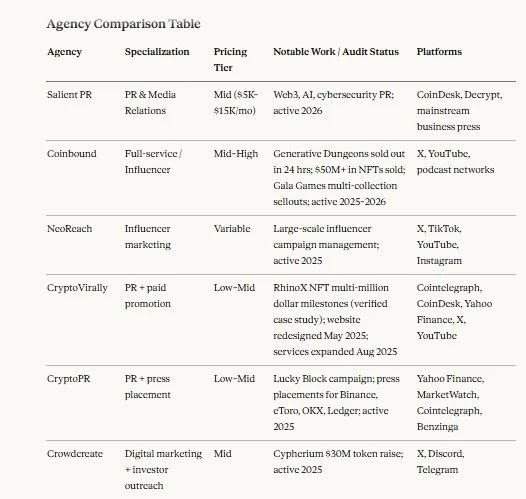
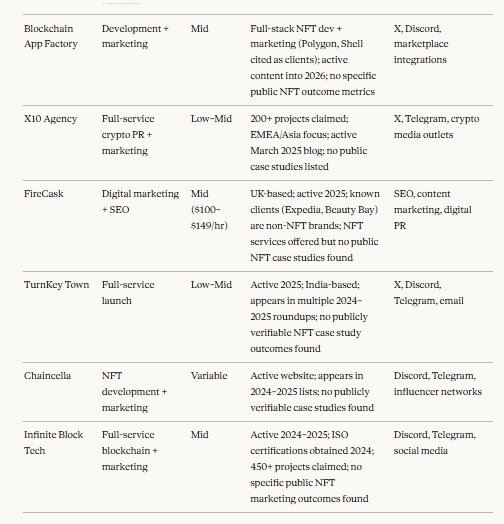
Before finalizing your shortlist: agencies with no public case studies aren't necessarily poor performers many work under NDA or don't publish outcome data. But you should ask for verified references before committing budget.
NFT Influencer Marketing
Influencer marketing remains one of the most effective awareness channels for NFT projects — when done right. The NFT influencer space has its own ecosystem of creators, with audiences that range from retail speculators to serious collectors and institutional observers.
Platform Strategy
X/Twitter is still the primary platform for NFT culture. NFT influencers on X range from accounts with 10K followers in a specific niche (gaming NFTs, 1/1 art, PFP projects) to major crypto personalities with millions of followers. Micro-influencers in the 10K–100K range often drive higher engagement and more qualified buyers than mega-accounts. Typical rates range from $500–$5,000 per sponsored post depending on audience size and engagement.
YouTube is effective for longer-form project walkthroughs, founder interviews, and "why I'm investing in X" style content. A credible YouTube review from a respected crypto channel carries significant weight with serious collectors. Rates typically range from $2,000–$25,000 for dedicated videos.
TikTok drives volume and awareness but typically skews younger and more speculative. Effective for PFP projects and gaming NFTs targeting a broader retail audience. Rates vary widely — $200 to $10,000+ depending on creator tier.
Influencer Selection Criteria
Before signing any influencer deal:
Verify follower authenticity with a tool like HypeAuditor or SparkToro
Check their recent engagement rates — not just follower counts
Review their disclosure practices (FTC compliance matters)
Confirm their audience aligns with your buyer profile
Ask for examples of past NFT promotions and what outcomes they drove
What Agencies Like NeoReach and Crowdcreate Do Differently
Agencies specializing in influencer marketing bring a vetted roster of creators, handle contracting and compliance, and coordinate timing across multiple influencers for launch amplification. They also track campaign performance — impressions, link clicks, wallet connections, mints — rather than just posting and hoping. If you're managing more than two or three influencer relationships simultaneously, an agency with established infrastructure is typically worth the added cost.
NFT Community Management
Community is the foundation of any successful NFT project. A strong Discord or Telegram community can sustain floor prices, generate organic word-of-mouth, and provide direct feedback loops to creators. A neglected community can collapse a project's reputation faster than any bad press.
What community management actually involves:
Daily moderation and engagement across Discord channels
AMA (Ask Me Anything) event coordination with founders and team
Holder communications — updates, roadmap progress, mint announcements
Onboarding new members and maintaining community rules
Tracking sentiment and flagging issues before they escalate
Typical cost: $2,000–$5,000/month for dedicated community management, depending on community size and activity level. Some agencies bundle this into broader retainers.
Community management for NFTs differs from standard social media management because Discord communities are real-time, high-velocity environments. Response time matters. Community managers need crypto literacy and the ability to handle technical questions from holders.
NFT Advertising: Paid Promotion Strategies
Organic reach alone rarely moves the needle for a launch. Paid advertising amplifies what's working organically and fills gaps in audience coverage.
Platform Options
Crypto ad networks (Coinzilla, Bitmedia, Cointraffic) allow placement across crypto-native websites and apps. These networks reach audiences already engaged with digital assets and typically convert better for NFT projects than general display networks.
Google Ads can be effective for driving traffic to project websites and landing pages, particularly for branded search terms and project-specific keywords. Note that Google has restrictions on certain crypto and NFT ad categories — a knowledgeable agency will know how to navigate these.
Meta (Facebook/Instagram) remains restricted for many crypto/NFT advertisers following 2021–2022 policy changes. Some project types can still run on Meta with approved ad accounts, but it requires an agency with experience navigating the approval process.
X/Twitter Ads allow promotion to audiences following specific crypto and NFT accounts — making targeting relatively precise. Promoted tweets from project accounts or partnership accounts can significantly amplify organic reach during launch windows.
Reddit can be effective for specific NFT communities but requires authenticity — overtly promotional content gets flagged quickly by moderators.
Paid NFT advertising is most effective as a launch amplifier, not a primary acquisition channel. Budget for paid alongside organic community building and PR rather than as a replacement for either.
NFT SEO: Organic Search for Token Projects
Most NFT projects ignore organic search entirely — which is a missed opportunity. Search traffic to NFT project pages, mint guides, and educational content can drive sustained awareness beyond launch windows.
Key SEO opportunities for NFT projects:
Project landing pages: Optimize title tags, meta descriptions, and on-page content for the project name and relevant category terms (e.g., "generative art NFT," "gaming NFT," "music NFT")
Educational content: How-to guides, explainers, and tutorials on your project's utility can rank for informational queries and introduce new audiences
Link building: Coverage in crypto media outlets (CoinDesk, Decrypt, The Block) generates high-authority backlinks that improve overall domain authority
Technical SEO: Fast load times, clean URL structure, and proper indexing matter — especially for mint sites that need to handle traffic spikes
NFT SEO is a longer-term play than PR or influencer marketing, but it compounds. A well-optimized project site continues to attract organic traffic months after launch without additional spend.
How Much Does NFT Marketing Cost?
NFT marketing agency pricing varies significantly based on scope, agency reputation, and campaign complexity. Here's a realistic breakdown by service tier:
Community Management Only
$2,000–$5,000/month
Daily Discord/Telegram moderation
AMA coordination
Holder communications
Basic reporting
PR + Marketing Retainer
$5,000–$15,000/month
Media outreach and press placement
Social media management (X, Instagram)
Content creation (press releases, blog posts)
Basic influencer coordination
Monthly performance reporting
Full-Service Launch Campaign
$15,000–$50,000+ (often structured as a project fee rather than monthly)
Complete go-to-market strategy
PR campaign with media placements
Influencer network activation
Paid advertising management
Community buildout and management
Content production (video, visual, written)
Analytics and performance tracking
One-Off Services
Single press release distribution: $500–$2,000
Influencer placement (single post): $500–$25,000 depending on creator
Strategy/audit consultation: $1,500–$5,000
The $10,000–$200,000+ total range often cited elsewhere reflects full campaign spend inclusive of ad spend and influencer fees — not agency retainer alone. Clarify this distinction when getting quotes.
Building a Strong Online Presence for Your NFT Project
A project's online presence needs to be coherent across every touchpoint — website, Discord, X account, and any press coverage. Buyers and collectors will check all of them before minting or purchasing.
Core elements of a credible online presence:
A clean, fast project website with a clear roadmap and team transparency
An active, moderated Discord with real community engagement
Consistent X/Twitter presence with regular updates from the team
Press coverage from recognized crypto or mainstream outlets
Verifiable team credentials (doxxed founders or clear pseudonymous track records)
Influencer partnerships, PR coverage, and community management all feed into online presence — which is why full-service agencies typically outperform single-channel specialists for launch campaigns.
Successful NFT Marketing Campaigns: What Worked
Notable campaigns that offer transferable lessons:
Nike's "Ducks of a Feather" — brand credibility and existing audience drove adoption; the NFT was positioned as an extension of an established community, not a speculative asset
NBA Top Shot — licensing legitimacy and cultural relevance (real game moments) gave collectors a genuine value proposition beyond speculation
Bored Ape Yacht Club — community-first strategy with clear holder benefits; the marketing was the community
Beeple's "The First 5000 Days" — PR-driven campaign that crossed into mainstream art and business press, reaching audiences outside the existing crypto ecosystem
The common thread: each campaign had a clear answer to "why does this exist and why does it matter?" before any marketing spend was deployed.
The Future of NFT Marketing in 2026 and Beyond
The NFT projects gaining traction in 2026 are those with clear utility: gaming assets with real in-game function, membership tokens with tangible holder benefits, loyalty programs tied to real-world brands, and creator economy tools that give fans genuine ownership of content they love. Marketing strategies have shifted accordingly — away from speculative FOMO and toward utility demonstration, community proof, and mainstream media credibility.
Agencies that understand this shift are building campaigns around earned media, long-term community development, and cross-over into non-crypto audiences. Agencies still running 2021 playbooks — Discord shilling, influencer pump campaigns, whitelist hype — are a liability, not an asset.
Tips for Maximizing ROI from NFT Marketing
Set measurable goals before engaging any agency: mint volume, floor price targets, Discord growth, media placements
Allocate budget across at least two channels — PR and community management at minimum
Track metrics that matter: mints, secondary volume, Discord retention, organic search traffic, media placements — not just follower counts
Build in a feedback loop: review performance monthly and reallocate budget based on what's converting
Don't conflate launch spend with ongoing brand building — they require different strategies and different agency skill sets
Legal and Compliance Considerations
NFT marketing operates in a sensitive regulatory environment. Any language that implies financial returns, promises appreciation, or positions an NFT as an investment can attract regulatory scrutiny. Key compliance considerations:
Avoid explicit or implied promises of financial return in any marketing materials
Ensure influencers properly disclose paid partnerships (#ad, #sponsored)
Address copyright and IP rights clearly before marketing begins — especially for projects using third-party creative assets
Work with agencies familiar with FTC disclosure requirements and, if applicable, SEC guidance on digital assets
Include clear terms of sale and transfer language
Measuring NFT Marketing Campaign Success
KPIs worth tracking:
Mint performance: Total minted, mint velocity, sell-through rate
Secondary market: Floor price trends, trading volume, holder distribution
Community: Discord member growth, daily active users, retention rate post-mint
Media: Number of placements, publication tier, estimated reach
Organic search: Branded search volume, project page traffic, inbound links
Social: X follower growth, engagement rate, share of voice vs. comparable projects
Use Google Analytics for web traffic, native Discord analytics for community data, and OpenSea/Blur analytics for secondary market performance. Most reputable agencies will provide monthly reporting across these dimensions as part of their retainer.
Summary
The NFT marketing landscape in 2026 rewards projects with genuine utility, credible teams, and marketing strategies built on earned trust rather than manufactured hype. The agencies that survived the market correction did so by developing real PR relationships, building authentic communities, and learning how to communicate NFT value to audiences beyond the crypto-native base.
When evaluating agencies, prioritize verified 2024–2026 case studies over legacy credentials, ask for specific media placements and community metrics, and match agency specialization to your project's actual needs. PR and community management form the credibility foundation; influencer marketing and paid advertising amplify what's already working.
For broader blockchain and digital asset PR strategy, see our full breakdown of [crypto PR agencies](INTERNAL LINK TO CRYPTO PR POST).
Frequently Asked Questions
How much does an NFT marketing agency cost? NFT marketing agencies typically charge $2,000–$5,000/month for community management only, $5,000–$15,000/month for PR and marketing retainers, and $15,000–$50,000+ for full-service launch campaigns. One-off services like press releases or individual influencer placements can be arranged for less. Total campaign spend, including ad spend and influencer fees, can range from $10,000 to $200,000+ for major launches.
What does an NFT PR agency do? An NFT PR agency handles media outreach to crypto and mainstream publications, develops project narratives for press coverage, writes and distributes press releases, coordinates founder interviews and media opportunities, and manages reputation and crisis communications. The goal is earned media placements in credible outlets — CoinDesk, Decrypt, The Block, Forbes — that drive awareness and credibility without paid placement.
How do you market an NFT project? Effective NFT marketing combines PR (earned media in crypto and mainstream outlets), community building (Discord, Telegram), influencer partnerships (X/Twitter, YouTube, TikTok), paid advertising (crypto ad networks, Google, X Ads), and organic content. The mix depends on budget, timeline, and target audience. PR and community management are typically the highest ROI channels for credibility; influencer marketing drives volume and awareness.
What is the best NFT marketing strategy in 2026? The most effective strategy combines clear utility communication (what does this NFT actually do?), earned media PR to build credibility, community-first development before and after launch, and targeted influencer partnerships with verified audiences. Projects that lead with hype rather than utility rarely sustain secondary market activity. The best campaigns position the NFT within a broader narrative — gaming, art, brand loyalty, or creator economy — that resonates outside existing crypto audiences.