
Brand vs Reputation: What's the Difference and Why It Matters
Last reviewed: May 2026
Justin Mauldin | Founder, Salient PR | Justin advises on brand and reputation strategy across enterprise B2B clients, working with executives on the alignment between brand promise and customer experience.
A brand is what your company says about itself. A reputation is what others say about your company. Your brand is the identity you craft through marketing, design, and messaging. Your reputation is the perception that forms in customers' minds based on their actual experience with you. You control your brand. You influence, but never fully control, your reputation.
Key Takeaways
A brand is the identity a company creates and controls. A reputation is the perception the public forms in response.
Brands are designed for endurance and consistency. Reputations shift based on customer experience, social media, and word of mouth.
Brand image and brand reputation are not interchangeable. Brand image is the visual and emotional impression; brand reputation is the trust and credibility earned over time.
Online presence and brand reputation overlap, but they are not the same. Online presence is your digital footprint; reputation is what people believe about you.
Active reputation management protects brand value, builds customer trust, and directly affects revenue.
What Is the Difference Between Brand and Reputation?
The difference between brand and reputation comes down to who creates it and who owns it.
A brand is created and controlled by the company. It includes the logo, tagline, color palette, voice, messaging, advertising, and the promises a business makes to its customers. Senior leadership and marketing teams shape it through deliberate strategy. The brand is what a company puts into the market.
A reputation is created by everyone except the company. It is the sum of every customer experience, every product review, every news article, every social media post, and every conversation about the business. It reflects what the market puts back. Reputation cannot be manufactured. It can only be earned, damaged, or repaired through action.
Both elements are tied together. A strong brand makes promises. A strong reputation proves the company keeps those promises. When the two align, customers trust the business and pay premium prices for its products. When they diverge, the gap erodes credibility quickly.
A company can change its brand in a single afternoon by approving a new logo. It cannot change its reputation in less than years of consistent behavior. Brand work is design and communication. Reputation work is operational, cultural, and relational.
This distinction matters for any executive deciding where to invest. Marketing spend influences brand. Customer service investment, product quality, employee experience, and crisis response shape reputation. Both deserve resources, but they are not interchangeable line items.
Brand vs Reputation: A Side by Side Comparison
The table below maps the core differences across the dimensions that matter most for business leaders.
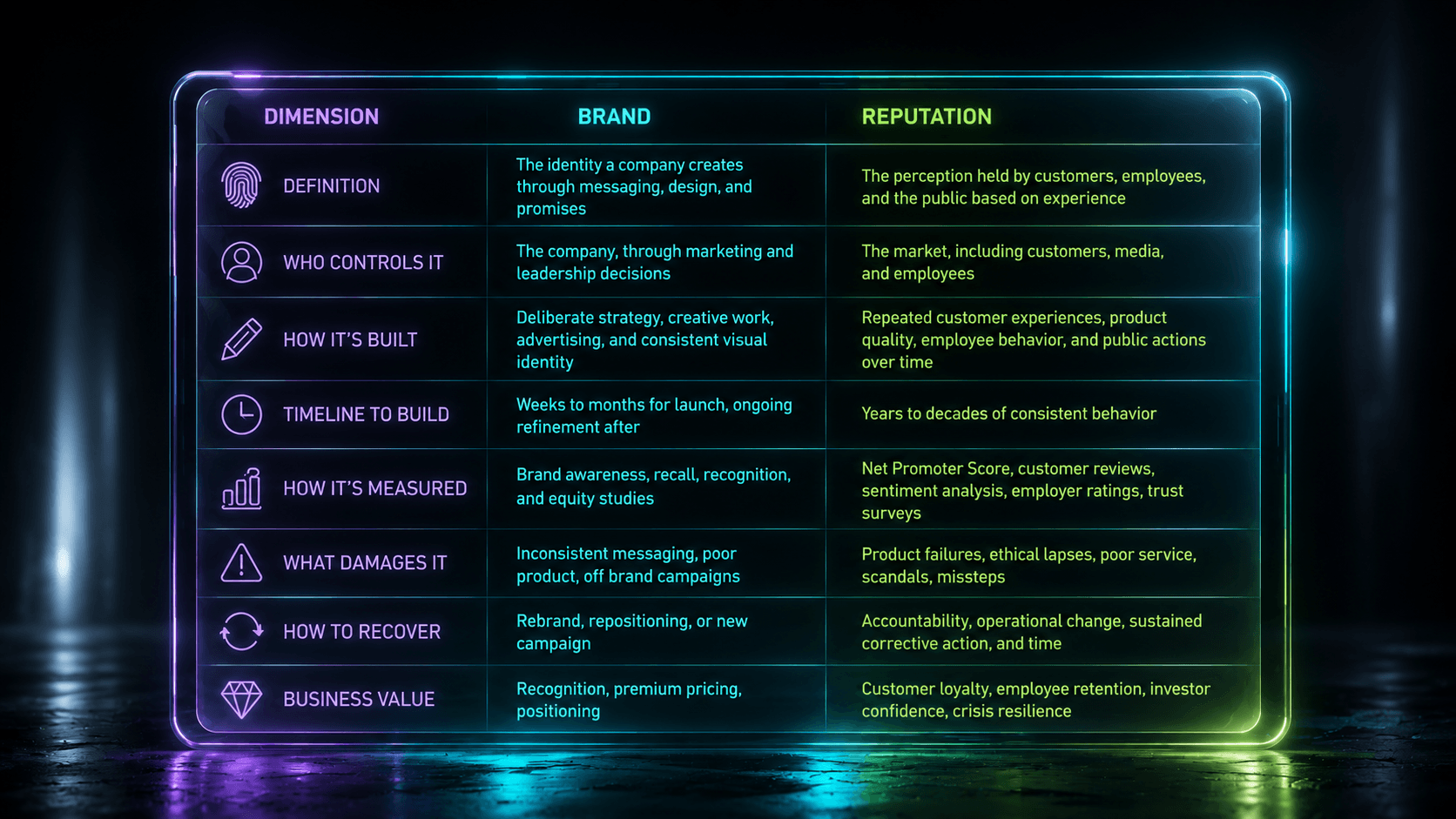
The most important row is the last one. A strong brand drives recognition; a strong reputation drives loyalty. Recognition gets a customer to try a product once. Reputation gets them to buy it again and recommend it to other people.
A brand without reputation is a billboard. A reputation without brand is a secret. The combination is what builds enduring market position. This is why companies that invest only in brand campaigns while ignoring product quality eventually collapse, and why companies with strong products but weak brands struggle to scale beyond a loyal niche.
Brand Reputation vs Brand Image: How They Differ
Brand image and brand reputation get used interchangeably, but they describe different things. Brand image is the immediate impression a company projects. Brand reputation is the accumulated judgment of whether the company can be trusted.
Brand image lives in the marketing materials, the website, the storefront, and the first customer touchpoint. Brand reputation lives in the second, third, and fortieth interaction, plus everything customers tell other potential customers afterward.
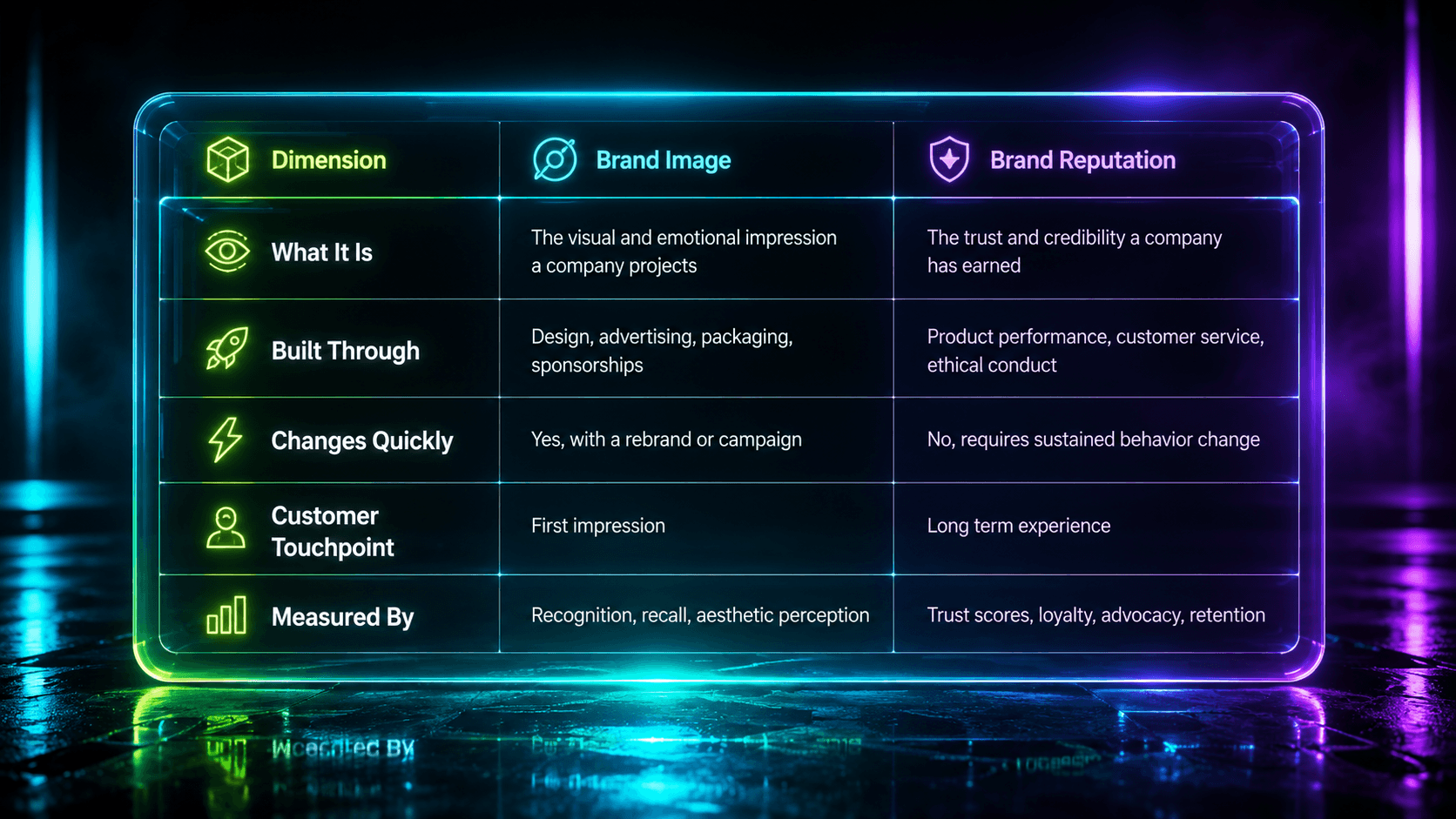
Apple illustrates the difference clearly. Apple's brand image is consistent and tightly controlled: minimalist design, premium materials, clean retail spaces, simple advertising. That image has barely shifted in two decades. Apple's brand reputation is more complicated. Customers associate the company with innovation, reliability, and design excellence. They also associate it with labor practices in its supply chain, repair restrictions, and pricing complaints. Both perceptions coexist. The image stays consistent because Apple controls it. The reputation is messier because the public shapes it.
This matters when planning communications. A new ad campaign can refresh brand image quickly. Changing brand reputation requires changes to the underlying business: how products are made, how customers are treated, how employees are paid, how crises are handled. PR teams that confuse the two end up spending creative budget on problems that need operational solutions.
Brand Reputation vs Online Presence: What Sets Them Apart
Online presence and brand reputation overlap, but they answer different questions. Online presence asks: where does this company show up when someone searches? Brand reputation asks: what do people believe about this company when they find it?
Online presence is the inventory of digital touchpoints a company controls or appears in. It includes the corporate website, social media profiles, Google Business listings, app store presence, search engine visibility, and any third party platform where the brand has a footprint. It is measurable. A company either ranks for a keyword or it does not. A LinkedIn profile either exists or it does not.
Brand reputation is the layer above that. It is what people think and say about the company once they encounter that digital footprint. A company can have an extensive online presence and a poor reputation. It can also have a thin online presence and a strong reputation among the people who matter to its business.
Review platforms sit at the intersection of the two. G2, Glassdoor, Trustpilot, and Google Reviews are part of online presence; they are visible search results. The content of those reviews is reputation; it reflects what customers and employees actually experienced. A company can optimize its presence on these platforms by claiming profiles and responding to reviews. It cannot optimize the reviews themselves without doing the operational work that earns better ones.
The practical implication is straightforward. Online presence is a marketing and SEO function. Reputation is a cross functional responsibility that touches product, service, HR, and executive leadership. Investing in one does not substitute for the other.
How Brand and Reputation Work Together
The strongest companies treat brand and reputation as a closed loop. The brand makes a promise; reputation tracks whether the company delivers on it. When the loop closes, the business compounds. When it breaks, the brand becomes a liability.
A brand promise creates customer expectations. If the company meets those expectations consistently, customers become advocates. Their stories become reputation. That reputation reinforces the brand for the next customer. The cycle repeats, and the business grows on momentum it no longer has to pay for in advertising.
When the brand promise does not match the customer experience, the loop breaks. The brand still attracts new customers, but each one has a worse experience than expected, leaves a negative review, and tells other people. Reputation erodes faster than brand spending can replace it. Marketing budgets balloon as the company tries to outspend its own bad reviews.
This is why brand strategy and reputation management belong in the same conversation. A creative team cannot design its way out of operational failures. A customer service team cannot deliver a brand experience it does not understand. Companies that succeed in the long term build the brand and the reputation in parallel, with the same leadership team accountable for both.
The companies that fail tend to treat brand as a marketing line item and reputation as a crisis communications problem. By the time a reputation problem becomes a crisis, the brand has already been damaged.
How Reputation Affects Business Success
Reputation is not a soft asset. It shows up in measurable business outcomes.
Reputation affects pricing power. Customers will pay more for products from companies they trust. They will accept higher margins, longer waits, and fewer features in exchange for confidence that the product will work and the company will stand behind it.
Reputation affects hiring. Strong employer reputations attract better candidates, reduce time to hire, and lower recruitment spend. Weak reputations force companies to overpay for talent or settle for candidates who could not get other offers.
Reputation affects deal flow. Investors, partners, and acquirers conduct diligence on reputation before signing contracts. A company with a damaged reputation pays a premium in every negotiation, from vendor terms to acquisition multiples.
Reputation affects crisis resilience. Companies with strong reputations have credibility reserves. When something goes wrong, customers and the press give them the benefit of the doubt while the company explains. The work of crafting a public relations statement becomes far easier when reputation gives the company room to be heard. Companies with weak reputations get no benefit of the doubt; every problem becomes a headline.
The financial impact is real even when it is hard to isolate. Reputation work pays for itself by reducing customer acquisition cost, improving retention, and protecting margin. Companies that cut reputation investment to save money in the short term tend to pay much more in the long term when they have to rebuild.
Real World Examples: When Brand and Reputation Diverge
The gap between brand and reputation becomes visible when something goes wrong. These four cases show how the two can move in opposite directions, and they are also the kinds of moments when companies turn to crisis management PR firms to help control the damage.
Volkswagen, 2015
For decades, Volkswagen built a brand around German engineering precision and clean diesel technology. The 2015 emissions scandal revealed that the company had installed software to cheat emissions tests across millions of vehicles. The brand identity stayed intact in the sense that the logo, advertising, and product line continued. The reputation collapsed. The phrase "German engineering" became "corporate fraud" in the public mind almost overnight. Volkswagen continued to sell cars, but trust took years to rebuild and the financial cost ran into billions of dollars in fines, settlements, and lost market value.
Patagonia
Patagonia is the rare example of brand and reputation moving as one. The brand promise is environmental responsibility and product durability. The reputation, built over decades, is that the company actually behaves that way. It donates a percentage of sales to environmental causes, encourages customers to repair rather than replace, and made headlines in 2022 by transferring ownership to a trust dedicated to fighting climate change. The brand does not have to argue for itself because the reputation already makes the argument.
Facebook to Meta
In 2021, Facebook rebranded its parent company as Meta. The new name and focus on the metaverse arrived during years of reputational pressure: privacy controversies, misinformation, mental health concerns, and antitrust scrutiny. The rebrand was a brand change. It did not resolve the reputation problems. Customers, regulators, and the press continued to apply the same scrutiny to Meta that they had applied to Facebook. The case is a clean illustration of a core principle: you can change a brand in a press release; you cannot change a reputation in one.
Boeing
Boeing spent decades building a brand around engineering excellence and aviation safety. The 737 MAX crashes in 2018 and 2019, followed by additional quality and manufacturing issues in subsequent years, eroded that reputation. The brand assets, including the name, logo, and global recognition, remain valuable. The reputation, which is the part that convinces airlines, regulators, and passengers that a Boeing aircraft is safe, has required sustained operational and cultural changes to rebuild. The case shows how reputation damage in regulated industries carries financial and operational consequences for years, not quarters, and why effective crisis PR strategies have to be paired with real operational reform to land.
How to Manage Brand and Reputation Together
Managing brand and reputation as separate functions is a common mistake. They require different tactics, but they share the same goal: alignment between what a company says and what it delivers.
A practical approach starts with three commitments.
Define the brand promise narrowly enough to deliver on it. A brand that promises everything cannot keep any promise. A brand that promises one specific thing, and then keeps that promise consistently, builds the kind of reputation that compounds over time.
Monitor reputation actively, not reactively. Use tools to track sentiment across review platforms, news coverage, social media, and employer review sites. Establish a baseline. Watch for changes. Respond to issues before they become crises, not after.
Treat the first sign of misalignment as urgent. When customer reviews start contradicting the brand promise, the brand is not the problem. The product, service, or operations are. Fix the source. Communications work cannot replace operational work.
For companies without an in house team for this, working with a PR partner that understands both brand strategy and proven reputation management strategies is the most efficient option. Salient PR works with B2B technology companies on exactly this intersection: building brands that earn trust, monitoring reputation across owned and earned channels, and responding when something needs attention.
Summary
Brand and reputation are not the same thing, and treating them as if they are is one of the most expensive mistakes a company can make. The brand is what the company says about itself. The reputation is what everyone else says about the company. Brand is built through marketing; reputation is built through behavior. Both matter. Both deserve investment. The companies that treat them as a connected system, where the brand makes a promise and the reputation proves the promise is kept, outperform competitors that treat one as a substitute for the other.
Frequently Asked Questions
What is the difference between brand and reputation?
A brand is the identity a company creates and controls through marketing, design, and messaging. A reputation is the perception the public forms based on experience with the company. The company owns its brand; the market owns its reputation.
What is brand reputation vs brand image?
Brand image is the visual and emotional impression a company projects, including its logo, design, and advertising. Brand reputation is the trust and credibility a company has earned through consistent performance over time. Image is the first impression; reputation is the long term verdict.
What is the difference between brand reputation and online presence?
Online presence is the company's digital footprint, including websites, social media, search visibility, and third party platforms. Brand reputation is what people believe about the company when they encounter that footprint. A company can have a strong online presence and a weak reputation, or the reverse.
How does reputation affect business success?
Reputation affects pricing power, customer retention, talent recruitment, deal flow, and crisis resilience. Strong reputations let companies charge more, hire faster, negotiate better terms, and recover from setbacks. Weak reputations create cost across every part of the business.
Can you change a brand but not a reputation?
Yes. A company can change its brand in a single decision through a new name, logo, or campaign. Reputation only changes through sustained behavioral and operational change over years. The Facebook to Meta rebrand is a clear example of changing a brand without resolving reputation issues.
Can a company control its reputation the same way it controls its brand?
No. A company controls its brand directly through marketing and design decisions. Reputation is influenced by the company's actions but ultimately shaped by customer experiences, public opinion, and third party coverage. Companies can affect reputation, but they cannot control it.
How can a company align its reputation with its brand?
Define a brand promise the company can actually deliver on. Build the operational systems to deliver it consistently. Monitor reputation through reviews, sentiment analysis, and direct customer feedback. When gaps appear between brand promise and reputation, treat the operations as the problem, not the communications.
Curious to learn more about how Salient PR can elevate your public relations? Visit our website to explore our services and success stories.