
Effective Messaging Strategies: How to Maximize Marketing Impact

Last reviewed: June 2026
Justin Mauldin | Founder, Salient PR | Justin manages PR strategy and media relations across enterprise B2B clients, working directly with journalists and outlets daily.
Messaging marketing can make or break a brand's connection with its audience. Striking the right chord requires insight, strategy, and a touch of creativity. This article gets straight to the point on how you can capture attention and inspire action with well-crafted messages that echo across your marketing channels. We provide a clear road map to leveraging messaging for enhanced brand recognition and customer engagement — with real-world examples and practical frameworks to guide your journey. Research backs the stakes: consistent brand messaging across all platforms can boost revenue by up to 23% (Lucidpress/Forbes).
Key Takeaways
To capture audience attention effectively, marketing messages must be shaped by storytelling and emotional connections, aligned with brand values, and consistently distributed across channels.
Marketing messages should be simple, clear, and adapted to the audience's tone, employing high-impact words for emotional resonance and tailored for various cultural nuances across channels.
Successful marketing messages are integrated with company goals, refined through customer feedback to drive sales, and continuously improved for clarity, avoiding jargon and ensuring stakeholder alignment and effective team use.
Unlocking the Power of Messaging Marketing
In the face of dwindling attention spans, a powerful marketing message is crucial. It can significantly enhance lead generation, brand awareness, and customer retention, making it a cornerstone of successful marketing. But how can your brand's message swiftly capture your audience's attention? The answer lies in storytelling, which enhances retention, persuasive words that trigger action, and consistent messaging across channels that multiplies impact. In fact, brands with consistent cross-channel messaging strategies achieve 23% higher revenue growth, according to McKinsey research.
We'll probe further into harnessing this potential through clear definition of your brand's core message, pinpointing your audience's pain points, and comprehending the significance of emotional connections.
Defining Your Brand's Core Message
Core brand values are the fundamental beliefs that guide a company's actions, behaviors, and decision-making. These values are embodied in the brand's core message, which forms the foundation of all its marketing efforts. Effective core values are actionable, memorable, and accessible to all stakeholders. They guide strategic decisions, reinforcing team alignment, and providing a clear company direction.
A well-defined core message resonates with customers at a subconscious level, influencing purchasing decisions, and fostering deeper connections. Strategic communication of these values can give brands a competitive edge and make them more noticeable to consumers.
Identifying Audience Pain Points
Grasping your audience's pain points is key to creating marketing messages that genuinely resonate. These pain points refer to issues affecting your audience's daily life, which they are actively seeking solutions for. By crafting your marketing message to address these identified audience pain points, your business can position itself as the problem solver, and this can significantly impact your brand's appeal and customer retention.
Burger King's "Have it Your Way" brand awareness campaign — launched in 1974 — is a classic example of a brand aligning its message with the audience's desire for individualization. The slogan gave customers permission to customize their orders, positioning Burger King as the anti-McDonald's at a time when standardization dominated fast food.
The Role of Emotional Connection
Emotions significantly influence the bond between consumers and a brand. Emotional connections enhance brand loyalty and advocacy and should feel natural, reinforcing the brand's value in customers' lives. Emotionally charged messages are more memorable, helping brands connect with the heart and soul of the audience and create lifelong brand advocates. Nevertheless, emotional connections in marketing need to be managed with utmost care.
McDonald's UK TV ad, which used a story about a boy and his deceased father to sell Filet-O-Fish sandwiches, was pulled after widespread criticism for exploiting childhood grief — showing that emotional connections in marketing must be handled with care.
Crafting Messages That Resonate
After comprehending your brand's core message and pinpointing your audience's pain points, the ensuing step is to formulate messages that echo with your audience. Effective marketing messages require a deep understanding of your target audience, a clear definition of your value propositions, and a knack for simplicity and clarity. Your brand's tone and the way you adapt your message across different channels also play a significant role in how your message resonates with your audience.
Simplicity is Key: To the Point and Self-Explanatory
When formulating messages that echo with your audience, simplicity is paramount. Effective marketing communication must be understandable by a broad audience, avoiding complex industry-specific jargon. Simple, clear, and straightforward messaging ensures that your communication remains comprehensible, aiding in brand recognition and recall.
Brands like Apple, Nike, and Trader Joe's highlight the benefits of simple marketing, from minimalist design to straightforward taglines.
Tailoring Tone for Your Audience
The tone of your marketing message is a vital component that can either foster or fracture your bond with your audience. It's important to set a tone for the marketing message that resonates with the desired feelings of the audience. Using high-impact words that evoke emotion or imagery can significantly enhance your message's effectiveness. Some examples of high-impact words include:
Powerful
Exclusive
Revolutionary
Unforgettable
Life-changing
By incorporating these words into your marketing message, you can create a strong emotional connection with your audience and increase the effectiveness of your communication.
Creating audience personas based on detailed demographic, psychographic, and geographic data can guide you in tailoring your brand voice to resonate with your audience.
Consistency Across Different Channels
Maintaining uniformity in your marketing message across various channels is another significant factor in creating messages that echo with your audience. This approach creates a unified narrative that builds a cohesive brand image, reinforcing key messages. According to Lucidpress research, consistent brand presentation across all platforms can increase revenues by up to 23%.
While consistency is key, it's also important to adapt your messaging to be accessible to all segments of your target audience, taking into consideration the voice, tone, and style that may vary depending on cultural nuances.
Elevating Your Strategy with Marketing Messaging
Having crafted your marketing message, the question arises: how can you guarantee its alignment with your overarching marketing strategy? The answer lies in aligning your marketing messages with your company goals, refining them for sales success, and incorporating feedback to continually improve your messaging.
Aligning with Company Goals
Ensuring that your marketing messages align with company objectives keeps your messaging in sync with your business's aspirations. This alignment is crucial for:
Growth
Profitability
Increasing brand loyalty
Forming part of a cohesive brand narrative
For successful marketing campaigns, marketing messages must be consistent across marketing communications, with objectives and resources aligned with the company's broader business goals for maximum impact.
Refining Messages for Sales Success
Your marketing messages function as a key driver of sales. By integrating marketing messaging into sales strategies, you can enhance your business's ability to communicate its value proposition effectively, leading to increased sales and better customer relationships.
Effective marketing messaging can generate more leads by stimulating interest, providing sales teams with a larger pool of potential customers.
Continuous Improvement Through Feedback
Customer feedback is a treasure trove of insights, aiding in fine-tuning your marketing messages. Incorporating this feedback fosters a sense of value among customers, leading to greater satisfaction and loyalty.
Addressing customer questions based on feedback can create marketing content that is more relevant and helpful, improving the customer experience across social media and other channels.
The Anatomy of a Strong Marketing Message
Effective marketing messages need to be:
Concise
Simple
Relevant
Persuasive
Meaningful
Enduring
Each of these qualities helps capture attention and drive closer to business goals.
Core Messages as Your Foundation
Your core messages form the foundation of your brand messaging and corporate messaging. These messages encapsulate your company's values and promises to customers, staff, and the community. A well-crafted messaging document can help ensure consistency and clarity in conveying these core messages.
A core marketing message is the primary communication used to convey the value of a business and convince the audience to engage with the brand.
Value Propositions That Differentiate
Differentiation is a crucial aspect of crafting a strong marketing message. Your value proposition is a concise statement that explains why customers should choose your products or services over competitors, articulating the specific solutions and value they can expect to receive.
Avoiding Jargon for Clear Communication
Employing jargon can frequently muddle your marketing message, undermining its clarity and impact. It's crucial to avoid jargon in your messaging to ensure that your communication is punchy, memorable, and resonant with customers.
Messaging Framework Templates
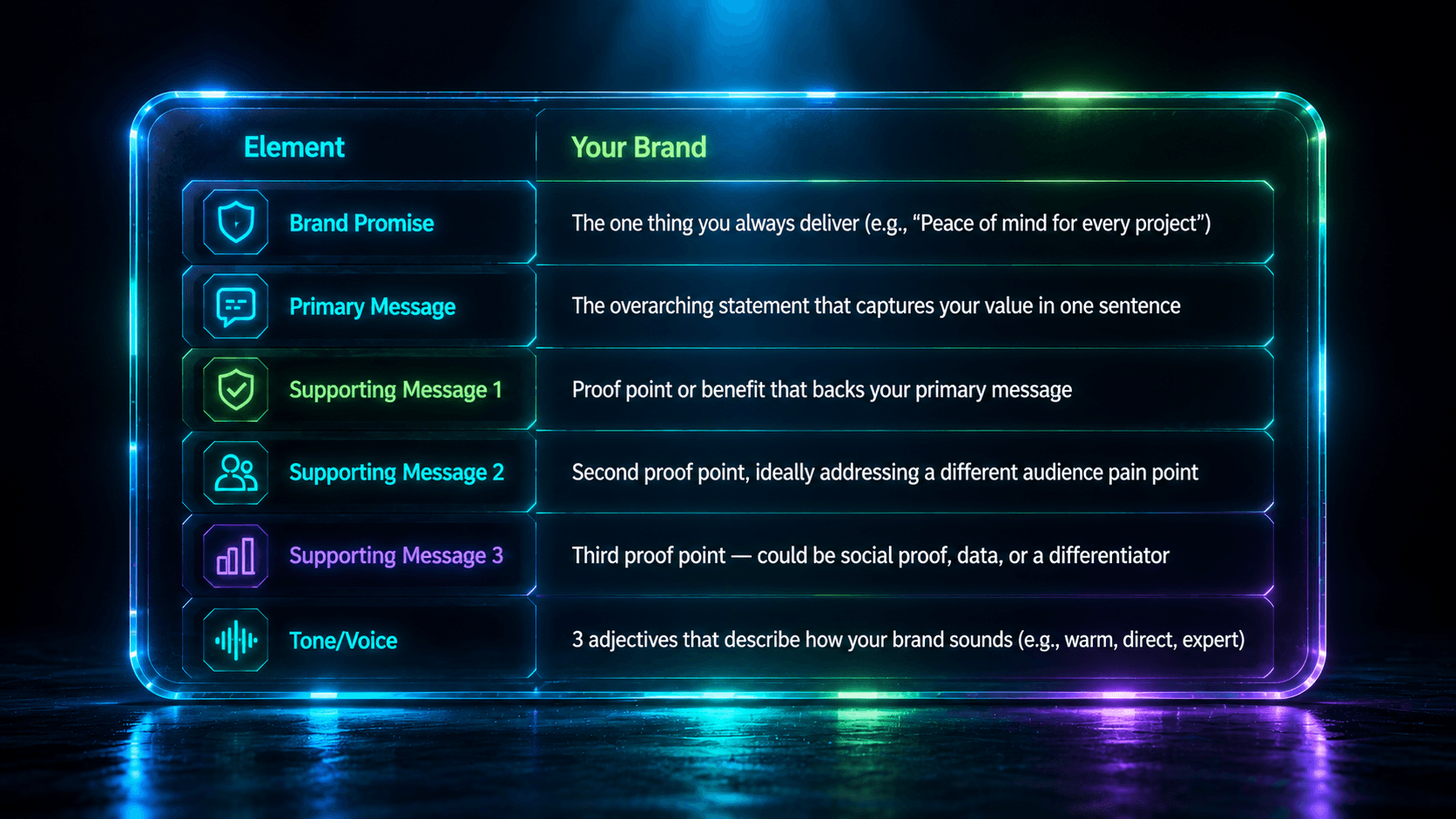
A messaging framework gives your team a shared foundation to work from — so every channel, campaign, and conversation reinforces the same story. Below are three practical templates you can adapt for your brand.
Template 1: The Core Messaging House
Template 2: The Problem-Solution-Proof Format
Use this for landing pages, ads, and sales emails:
Pain point: Start with the specific problem your audience is experiencing.
Bridge: Acknowledge the frustration or gap.
Solution: Introduce your product or service as the answer.
Proof: Back it up with a stat, testimonial, or case study.
Call to action: Tell them exactly what to do next.
Example: "Managing five marketing channels and still getting inconsistent results? Most brands struggle to keep their voice aligned across platforms. [Brand] gives your team a single messaging system that every channel runs from — so your customers hear one clear story, every time. Brands using consistent messaging report up to 23% higher revenue. Book a free strategy call today."
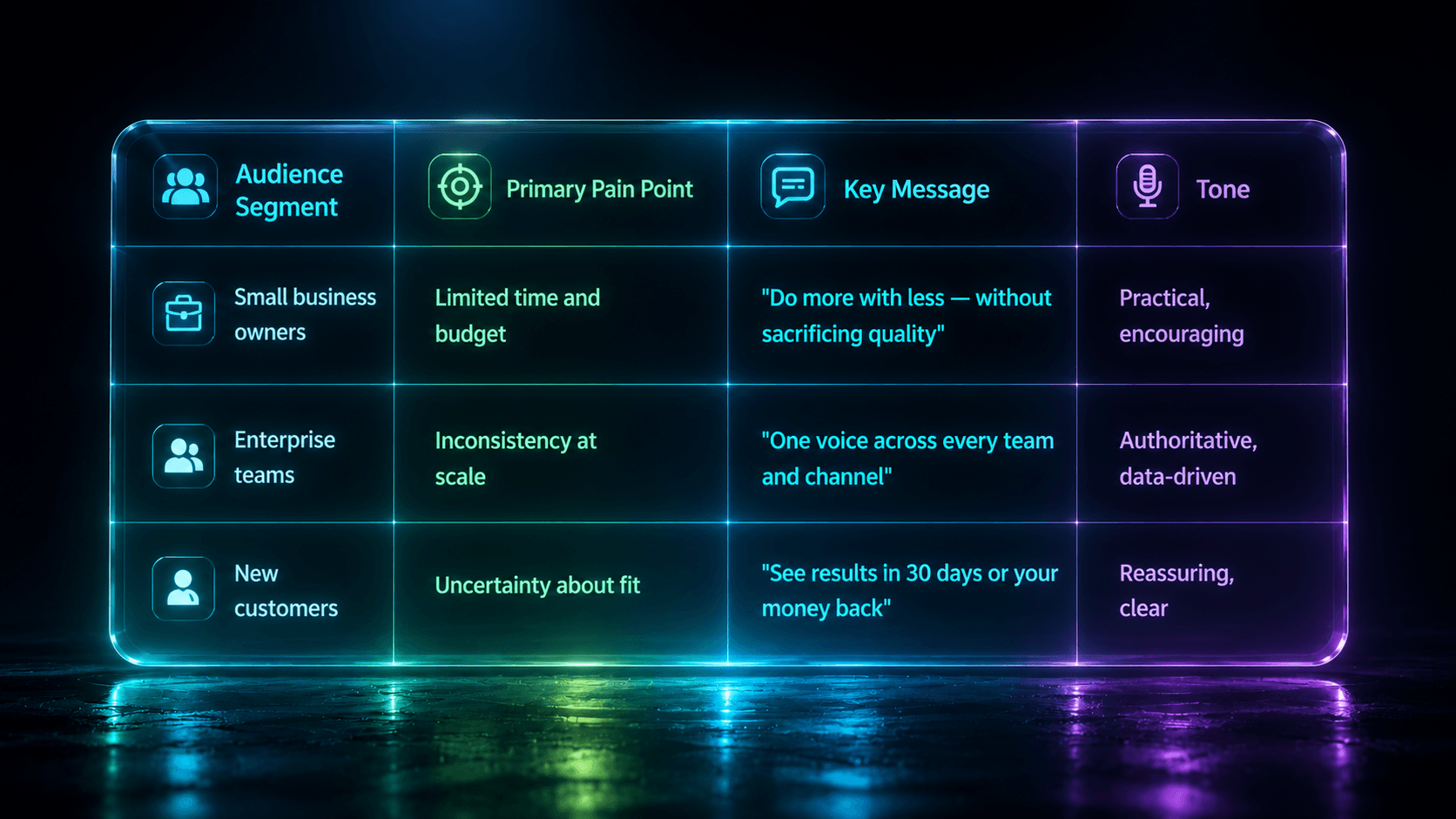
Template 3: The Audience-First Message Map
When speaking to multiple segments, map your core message to each audience:
Case Studies: Marketing Message Examples
How Real-Life Brands Craft Their Messages
Brands like Airbnb and Snickers have effectively crafted messages that connect with their audience and address their needs. Airbnb's "Belong Anywhere" campaign — launched in 2014 — repositioned the brand from a simple lodging platform to a facilitator of global belonging, connecting with the universal desire for authentic travel experiences. The campaign helped grow the user base from 40 million to over 60 million in just over a year.
Lessons Learned From Others' Successes and Failures
Lessons can also be learned from unsuccessful campaigns. Pepsi's 2017 ad featuring Kendall Jenner was widely condemned for trivializing protest movements, and Sony's 2006 "White is Coming" PSP campaign in the Netherlands was pulled after being criticized for racist connotations. Both cases demonstrate the necessity for marketers to ensure authentic, culturally sensitive representation in their messaging.
Implementing Your Marketing Messages
Following the creation of your marketing message, the subsequent step involves disseminating it across your marketing channels.
Internal Alignment with Stakeholders
Internal alignment with stakeholders is a crucial step in implementing your marketing messages. Ensuring stakeholders are involved in campaign planning is critical for coordinated scheduling and activity management.
Training Teams to Use the Right Message
Training your teams to use the right message is a crucial aspect of implementing your marketing messages. Various training formats should be utilized to help teams grasp and utilize messaging frameworks in different contexts. These formats include:
Workshops
Webinars
Videos
Quizzes
Role-plays
Feedback sessions
Measuring Success and Making Adjustments
After deploying your marketing messages, it's vital to gauge your success and make necessary modifications. Setting marketing objectives that are Specific, Measurable, Attainable, Relevant, and Time-bound (SMART) is essential for alignment with company goals.
Summary
Effective marketing messaging is no simple feat. It requires a deep understanding of your brand's core values, your audience's pain points, and the art of crafting messages that resonate. From defining your core message and identifying what drives your audience, to maintaining consistency across channels and measuring what works — every element plays a role. Use the framework templates above as a starting point, learn from both brand successes and failures, and commit to refining your messaging over time.
Frequently Asked Questions
What is messaging in marketing example? Messaging in marketing is the way a company communicates its unique value proposition to its target audience. An example is Walmart's message "Save money, live better," which emphasizes its lower prices compared to competitors like Target.
What is messaging in product marketing? Messaging in product marketing is the essential communication used to effectively convey the value of your product to the target audience, shaping their understanding and addressing their needs. It involves constant refinement based on customer research and understanding.
What is a messaging platform in marketing? A messaging platform in marketing is a foundational document that outlines the key messages, value proposition, and unique selling points of your company's product or service offering. It serves as the basis for all marketing and advertising campaigns, ensuring consistency and effectiveness across all channels.
What is a messaging strategy in marketing? A marketing messaging strategy is how you communicate and position yourself with your target audience. It guides your communications and ensures your messaging aligns with your brand and your audience at every step in the customer journey. Understanding your audience's interests, competition, and what makes your company unique is critical for long-term brand success.
What is the importance of messaging in marketing? Messaging in marketing is crucial as it significantly impacts lead generation, brand awareness, and customer retention by capturing the audience's attention and resonating deeply with them. Research shows consistent messaging alone can increase revenue by up to 23%.
Curious to learn more about how Salient PR can elevate your public relations? Visit our website to explore our services and success stories.