
Top PR Firms in Washington, DC: Political PR, Public Affairs & Communications Agencies

Last reviewed: May 2026
Justin Mauldin | Founder, Salient PR |Justin has spent the past five years working directly with journalists, editors, and communications professionals across Washington, DC and beyond evaluating PR firms, public affairs agencies, and strategic communications partners on behalf of B2B clients navigating federal markets, regulatory environments, and policy-driven media landscapes.
Washington, DC doesn't operate like any other PR market in the country. Where most cities sit at the intersection of business and media, DC adds a third layer — political power. A Senate subcommittee hearing can crater a company's stock. A White House announcement can reshape an entire industry overnight. Federal regulatory agencies here don't just oversee markets; they define them.
That's why the PR and communications firms operating in Washington aren't just pitching journalists. They're navigating congressional offices, federal agencies, advocacy coalitions, and a media ecosystem built entirely around policy and power. The best PR firms in Washington, DC understand that communications here is high-stakes by default — and that "high-stakes" often means federal.
Whether you need a communications firm fluent in Capitol Hill, one that specializes in crisis response when the fallout is congressional, or a boutique agency that knows the health policy beat inside and out, this guide covers the full landscape — who the players are, what they actually do, and what to look for before you sign anything.
Key Takeaways
Washington, DC's PR landscape requires firms with expertise across political communications, public affairs, regulatory strategy, and media relations — often simultaneously.
The best DC PR firms distinguish themselves by policy fluency, not just media contacts.
Specialized verticals — health policy, education, technology, and crisis — require agencies with genuine domain expertise, not generalists repackaging standard services.
The terms "PR firm" and "communications firm" are used interchangeably throughout Washington, DC. The best agencies operate across both functions.
Pricing for DC PR firms and communications agencies ranges from approximately $3,000/month for boutique or solo practitioners to $18,000–$25,000/month for premium full-service agencies.
Geographic proximity matters in some situations, but many of the strongest PR agencies serving DC clients operate on distributed or hybrid models.
DC's PR Landscape: A Hub for Policy, Business, and Communication
Washington, DC has long been called the issues and reputation capital of the world — and that label isn't hyperbole. Every major policy debate, regulatory shift, and political development that plays out in this city sends ripple effects across industries, markets, and public opinion nationwide. The decisions made in a single congressional hearing room or a federal agency conference call can redefine competitive landscapes, trigger market volatility, and reshape how entire sectors communicate with the public.
That environment creates a distinctive and demanding market for PR and communications expertise. Unlike markets where media relations and brand-building are the primary focus, DC communications firms must operate simultaneously across government relations, public affairs, media strategy, stakeholder engagement, and crisis communications — often within the same client engagement and sometimes within the same week.
The industries that rely on DC communications firms are as varied as the city itself. Healthcare and pharmaceuticals, defense and government contracting, financial services, technology, education, nonprofits, trade associations, and foreign governments all maintain significant presences in Washington, and all require communications partners who understand both their sector and the political environment surrounding it.
The result is a PR market that rewards specialization. Generalist agencies can find work here, but the firms that consistently win and retain high-value clients are those with deep domain expertise — in health policy, regulatory affairs, political communications, crisis response, or public affairs — combined with the media relationships and political fluency that only come from operating in Washington long-term.
The Need for High-Quality PR Firms in Washington, DC
DC's blend of politics and business demands communications firms with a real understanding of how those worlds interact and where they collide. A product launch in New York is a business story. The same announcement in Washington might require navigating a pending regulatory review, a congressional oversight inquiry, a dozen conflicting advocacy group interests, and a national security angle — before a single reporter gets briefed.
A single regulatory ruling can rewrite a company's market position. A congressional hearing can define — or destroy — a brand's reputation within a 48-hour news cycle. The communications firms that succeed in Washington are the ones who can read both the political environment and the media landscape simultaneously, and who have the relationships and experience to act on what they're reading.
This requires teams built from diverse backgrounds: former Capitol Hill staffers who understand legislative communication, journalists who know what makes a DC story move, policy experts who can translate regulatory complexity into plain language, and crisis specialists who've managed situations where the consequences are federal, not just reputational.
PR Services Offered by DC Communications Firms
Leading PR and communications firms in Washington, DC provide a range of services that go well beyond standard media relations. Brand strategy, messaging architecture, content development, digital strategy, executive positioning, government communications, stakeholder engagement, and crisis management are all part of the toolkit that full-service DC firms bring to their clients.
Content creation and social media strategy extend a brand's reach and drive engagement — but in DC, the audiences for that content are often as much policymakers and Hill staffers as they are consumers and investors. That changes the strategy considerably.
For organizations with policy exposure, DC communications firms also provide services specifically oriented toward the political and regulatory environment: activating advocacy bases, developing materials for policymaker briefings, supporting testimony preparation, managing public comment periods for federal rulemakings, and building coalitions across stakeholder groups that may have conflicting interests.
Do I Need a PR Firm Based in Washington, DC?
It depends on what you're trying to accomplish. If you need hyper-local DC presence — in-person government meetings, Hill relationships built through direct access, or a team that's physically present for congressional appearances — then a Washington, DC-based firm matters. If your primary need is federal market communications or government relations PR, proximity can be an asset.
But if you're primarily looking for the best-performing PR or communications agency for your sector, geography is less important than domain expertise. Many of the strongest agencies serving DC clients today operate on distributed models. Salient PR, for example, is a distributed boutique that specializes in AI, cybersecurity, SaaS, and venture-backed startups — sectors with significant DC footprints — without requiring physical DC presence to deliver strong results.
Best PR Firms in Washington, DC
The firms leading DC's PR market in 2026 span a wide range of specializations. The political environment shifts with each administration and election cycle, which means the communications landscape here evolves in ways that firms in other markets simply don't have to track. Here's a look at the firms consistently operating at the top of the Washington, DC market.
1. Merritt Group: Technology, Health, and Government Focus
Merritt Group has built its reputation around a specific challenge: helping innovative companies communicate complex ideas to buyers in technology, health, and government sectors. Their work spans branding, storytelling, digital transformation, and pipeline development — all oriented toward helping clients break through in technically complex markets with discerning government buyers.
Their Silver award at the Bulldog Awards reflects a consistent track record in earned media and campaign performance. For technology and health companies trying to penetrate the federal market, Merritt Group is one of the strongest boutique options in Washington.
2. Simoneink: Hospitality Industry Expertise
Simoneink occupies a well-defined niche in DC's communications landscape: hospitality. Their services cover advertising development, branding, copywriting, and event planning — all tailored to a sector that requires specific expertise and, in Washington, operates in a city that hosts more high-profile events than almost anywhere else in the country. For hotels, restaurants, and hospitality brands with significant DC exposure, Simoneink brings vertical depth that generalist firms can't replicate.
3. Xenophon Strategies: Crisis Management and Public Affairs
Xenophon Strategies is one of DC's go-to communications firms for high-stakes crisis management and public affairs work. Their client roster includes Airbus and Alaska Airlines — organizations where a communications failure carries real operational, reputational, and regulatory consequences. Their recognition for Public Affairs Campaign of the Year from the Public Relations Global Network reflects a track record built on situations where the margin for error is thin.
For organizations facing politically charged crises or navigating complex public affairs challenges in Washington, Xenophon's combination of crisis experience and public affairs fluency is among the strongest options in the market.
4. APCO Worldwide: Global Public Affairs and Stakeholder Engagement
APCO Worldwide is one of the most prominent public affairs and communications firms with deep Washington roots. Known for stakeholder engagement, regulatory communications, and international public affairs, APCO operates at the intersection of business and government at a scale few firms match. Their work spans corporate reputation management, issue advocacy, and complex political environments across multiple sectors globally, with Washington as a core strategic hub.
5. JPA Health: Health Communications Specialist
JPA Health is a vertically focused health communications firm built specifically for the DC policy environment. Their practice spans public health campaigns, health policy communications, and pharmaceutical and biotech PR — work that requires direct familiarity with federal health agencies, congressional health committees, and the patient advocacy ecosystem that shapes health policy debates in Washington.
6. Salient PR: Distributed Boutique for B2B Tech, AI, and Cybersecurity
Not every strong DC communications partner needs to be headquartered in the city. Salient PR is a distributed boutique specializing in AI, cybersecurity, SaaS, and venture-backed startups — sectors with significant and growing DC footprints given the federal government's role in technology procurement, cybersecurity regulation, and AI policy. For companies that need a high-performing agency with genuine B2B technology depth, Salient PR delivers without the overhead of a large DC office.
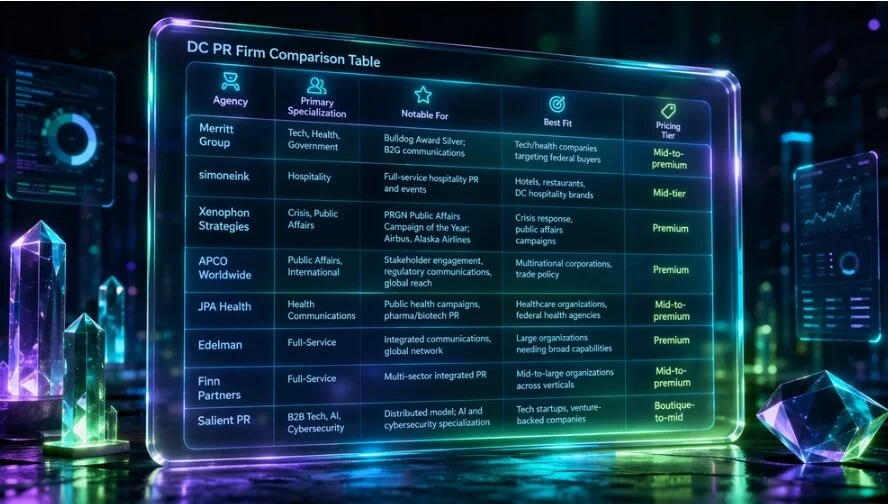
General DC market pricing: boutique/solo ~$3,000–$6,000/month; mid-tier agencies ~$8,000–$15,000/month; premium full-service agencies ~$18,000–$25,000/month. Project-based and crisis retainer pricing varies.
Political PR Firms in Washington, DC
Political communications is its own discipline — and Washington, DC has concentrated that expertise in ways no other American city has. The firms that specialize in this space operate under compressed timelines, intense and often partisan media scrutiny, and communications decisions that can carry electoral, legislative, or legal consequences.
Political PR in Washington encompasses several distinct functions, and the firms that do this work at a high level have typically built specific expertise in at least one of these areas rather than treating political communications as an extension of standard PR practice.
Campaign Communications
Campaign communications agencies manage the full communications arc of political campaigns — message development, rapid response strategy, media relations, paid media coordination, spokesperson training, and debate and public appearance preparation. The pace and pressure of campaign communications is fundamentally different from corporate PR: news cycles move in minutes during a campaign, a single poorly phrased statement can define a candidate's week, and the margin for slow response is essentially zero.
Firms known for serious campaign communications work in Washington, DC include GMMB, which has managed communications for major presidential and Senate campaigns; SKDKnickerbocker, which operates across political campaigns and corporate advocacy with an integrated communications approach; and Rational 360, which handles both political and corporate clients with a particular emphasis on rapid-response and earned media strategy.
Political Crisis Management
When a public official, political organization, or government contractor faces a crisis in Washington, the communications calculus is fundamentally different from a standard corporate crisis response. Congressional investigations, Inspector General inquiries, ethics complaints, partisan media environments, and situations where the communications response may itself become the subject of further inquiry — these require specialized experience that most corporate PR firms don't have.
Political crisis management in DC demands firms with people who've actually been in these situations: former congressional communications directors, former agency press secretaries, attorneys who understand how investigative processes intersect with media coverage, and strategists who know how to manage a story across both political and mainstream media simultaneously.
The stakes in political crisis communications aren't just reputational — they can be legal, electoral, and career-defining. That's a different standard than most crisis communications engagements, and it requires a different level of experience.
Government Relations and Lobbying Communications
Government relations firms occupy a space that deliberately blurs the line between lobbying, communications, and public affairs. These agencies help clients communicate with federal agencies, congressional offices, and regulatory bodies — not just pitching journalists, but actively shaping the information environment around specific legislative or regulatory outcomes.
For organizations with significant federal exposure — defense contractors, pharmaceutical companies, financial institutions, technology companies facing antitrust or AI regulatory scrutiny — a communications firm with genuine government relations depth is often as important as a traditional PR agency. The two functions increasingly overlap in Washington, and the firms that operate best at that intersection tend to have team members who've worked on both sides: inside government and outside of it.
PAC and Advocacy Communications
Political action committees and advocacy organizations have distinct communications needs that most PR firms aren't built to serve. Donor communications, grassroots mobilization messaging, coalition-building communications, earned media strategies built around policy outcomes rather than commercial goals — these require a specific combination of political strategy and public communications expertise.
DC has a significant concentration of firms specializing in exactly this work, operating at the intersection of political strategy, digital organizing, and earned media. SKDKnickerbocker and FP1 Strategies are among the firms with well-established advocacy communications practices in Washington.
Public Affairs Firms in DC
Public affairs is consistently confused with traditional PR — but in Washington, the distinction matters more than anywhere else. Traditional PR focuses primarily on media relations and brand reputation management. Public affairs is broader, more political, and more directly aimed at influencing policy outcomes: it encompasses regulatory strategy, government engagement, stakeholder mapping, coalition building, and communications specifically designed to shape legislative and regulatory environments.
In DC, public affairs isn't a subspecialty. For many organizations, it's the primary reason they have a communications partner here at all.
Public Affairs vs. Traditional PR: The Distinction That Matters in DC
The clearest way to understand the difference is through audience and intent. Traditional PR targets journalists, consumers, and investors. Public affairs targets policymakers, regulators, advocacy groups, trade associations, and the coalitions that determine how legislation gets written and how regulations get enforced.
A consumer packaged goods company running a standard PR campaign wants brand coverage and consumer engagement. That same company facing an FTC antitrust review needs public affairs: regulatory communications strategy, coalition engagement with industry associations and aligned advocacy groups, policy media relations, and a communications approach designed to influence the regulatory environment — not just sell product.
In Washington, DC, most organizations with significant policy exposure need both traditional PR and public affairs capabilities. But they require different expertise, different relationships, and the clearest strategic thinking about which audience matters most for a given situation.
Regulatory Communications
Regulatory communications is the practice of managing an organization's communications with and around federal agencies — EPA, FDA, FTC, FCC, SEC, CFPB, and dozens of sector-specific regulatory bodies. It includes preparing for regulatory hearings, managing public comment periods during federal rulemakings, developing messaging for interactions with agency staff, and monitoring the regulatory environment for developments that require a communications response.
Firms that excel at regulatory communications in DC combine deep policy expertise with disciplined message development and genuine agency relationships. APCO Worldwide has one of the most established practices in this space, with significant experience managing complex regulatory environments across multiple sectors.
Stakeholder Engagement in the DC Context
Stakeholder engagement in Washington means something more specific than it does in other markets. It includes congressional offices, federal agency staff, think tanks, trade associations, patient advocacy groups, environmental organizations, consumer advocacy groups, and specialized policy media — all of whom may have a direct stake in how a regulatory or legislative issue resolves for your organization.
The best public affairs firms in DC maintain genuine relationships across this full ecosystem. They know which advocacy groups hold real influence for a specific policy issue, which congressional committees have jurisdiction over their clients' sectors, and which policy reporters are covering the regulatory beat that matters. That knowledge takes years to build and is not transferable from a different market.
Policy Advocacy Communications
Policy advocacy communications sits at the intersection of public relations, government affairs, and paid media strategy. It involves building public and political support for specific policy positions through a combination of earned media, targeted paid media, coalition engagement, digital organizing, and direct government outreach — all coordinated around a single strategic communications objective.
For trade associations, advocacy organizations, and corporations with significant policy exposure, this function is often the most valuable thing a DC communications firm can provide. The firms best positioned to deliver it authentically are those with real relationships across the city's policy ecosystem — not just media contacts, but genuine government affairs experience and a track record of running policy campaigns that actually moved outcomes.
Strategic Communications Firms in Washington, DC
In Washington, DC, the terms "PR firm" and "communications firm" are used interchangeably — and the distinction is increasingly blurred by design. The agencies operating at the highest level in this market have evolved well beyond pure media relations into full-spectrum strategic communications: messaging architecture, executive positioning, policy communications, digital strategy, and crisis response, integrated under one roof.
This is part of what makes Washington unique as a communications market. The challenges here are complex enough that PR alone — in the traditional sense of pitching journalists and distributing press releases — is rarely sufficient for organizations with significant policy or political exposure. The best strategic communications firms in Washington, DC function as advisors first and tacticians second, helping clients understand the environment before helping them respond to it.
Health Policy PR & Communications in DC
Health policy is one of the most active and best-resourced communications arenas in Washington. The FDA, NIH, CMS, and CDC sit alongside congressional health committees, Senate HELP committee, powerful patient advocacy organizations, and a robust health policy media ecosystem that includes publications like STAT News, Modern Healthcare, and Politico's dedicated health policy coverage. The communications environment for health-related organizations in DC is uniquely complex and uniquely consequential.
FDA Communications
For pharmaceutical and biotech companies, FDA communications is a specialized discipline that requires understanding both scientific complexity and regulatory process. Managing public perception during a drug approval process, responding to adverse event reporting, and navigating the communications environment around clinical trial data all require firms with specific expertise in how FDA decisions get covered, how patient advocacy intersects with regulatory timelines, and what kinds of communications can and can't happen during pending regulatory proceedings.
Health Policy Advocacy
Health policy advocacy communications covers Medicare and Medicaid policy, prescription drug pricing, public health emergency response, mental health parity, and the ongoing legislative debates around healthcare access and insurance markets. Organizations across the spectrum — patient advocacy groups, hospital systems, pharmaceutical manufacturers, insurance companies, and public health nonprofits — all have significant stakes in how these debates play out in Washington, and all need communications partners who can operate fluently across both policy media and government audiences.
JPA Health has built its practice specifically around this environment, with expertise spanning public health campaigns and health policy communications in DC.
Pharma and Biotech PR
Pharmaceutical and biotech companies face a particularly pressured communications environment in Washington in 2026. Drug pricing has been a congressional priority across multiple election cycles, the Inflation Reduction Act's drug negotiation provisions remain a live communications challenge for pharma companies, and regulatory scrutiny is ongoing. PR and communications firms serving this sector need to manage reputations simultaneously with policymakers, patient advocates, journalists, and the general public — often with genuinely conflicting interests across those audiences.
Public Health Campaigns
Federal agencies including CDC, NIH, and SAMHSA engage communications firms to support public health campaigns — vaccination outreach, disease awareness initiatives, behavioral health campaigns, and public health emergency response. Firms that win this work typically combine government contracting experience with genuine health communications expertise, a combination that requires navigating both procurement processes and rigorous scientific messaging standards.
Education PR Agencies in DC
Washington, DC hosts a dense concentration of education-focused organizations: the Department of Education, NSF, major research universities, education-focused think tanks, and a robust ecosystem of advocacy organizations and K-12 reform groups. The communications needs across this sector are significant and varied, and the DC-specific dimension — proximity to federal education policy — shapes nearly all of it.
Think Tank Communications
Washington's think tank ecosystem — which spans organizations across the political spectrum — relies heavily on strategic communications to ensure their research reaches policymakers, journalists, and the public at the right moment. Think tank PR requires expertise in translating dense policy research into accessible narratives, building relationships with specific policy reporters and congressional staffers, and timing releases to align with legislative calendars and regulatory windows.
The goal is rarely just press coverage. It's ensuring that research lands in the right hands at the moment when it can actually influence a policy decision.
University PR in the Policy Capital
Major research universities with significant DC presences — Georgetown, George Washington University, American University, and others — need communications support that spans research announcement strategy, leadership and faculty positioning, and government relations. University PR in DC carries an added dimension that doesn't exist in most other markets: proximity to federal research funding agencies means that research communications often needs to speak simultaneously to academic media and federal policy audiences.
Education Policy Advocacy
Education policy is a consistent source of high-stakes communications work in Washington. Charter school policy, student loan reform, Title I funding debates, and federal education standards all attract well-funded advocacy campaigns from organizations across the political spectrum. Communications firms working in education policy need to navigate polarized media environments, build coalitions across audiences with conflicting views, and manage earned media strategies that operate simultaneously at the federal and state levels.
K-12 Reform Communications
K-12 education reform organizations — national nonprofits, state-level advocacy groups, and foundation-funded initiatives — often use Washington as a base for federal advocacy while running state and local campaigns simultaneously. The PR and communications firms that serve this segment need multi-level capability: federal policy communications in DC combined with local earned media strategies in target markets.
Crisis Management PR Firms in DC
Crisis communications is a standard service across the PR industry. In Washington, DC, it's a different discipline entirely — and the difference matters.
The crises that DC-based communications firms manage most often aren't product recalls or executive misconduct, though those happen too. They're congressional investigations, Inspector General findings, federal regulatory enforcement actions, political scandals with national media attention, and situations where the communications response may itself become the subject of additional oversight. For a deeper look at how to evaluate and engage [crisis management PR firms](LINK TO CRISIS MANAGEMENT POST), including what to look for in a crisis retainer and how to assess firm experience before you need it, see our comprehensive guide to DC crisis management PR firms.
Congressional Investigations
When an organization is the subject of a congressional investigation — a committee subpoena, an oversight hearing, or a broader inquiry — communications strategy becomes inseparable from legal strategy. The firms best equipped to handle this work in Washington are staffed with former congressional staffers, former Hill communications directors, and strategists who understand how investigative processes generate media coverage and how to manage a story in that environment without creating new legal exposure.
Regulatory Crises
Federal agency enforcement actions — an SEC investigation, an FTC antitrust proceeding, an FDA warning letter, a DOJ inquiry — require communications strategies that account for the specific constraints and audience dynamics of federal regulatory proceedings. What you can say, when you can say it, and to whom are all shaped by the regulatory process itself. Firms without experience in this environment routinely make communications decisions that damage the legal position, not just the reputation.
Political Scandals
Political scandal communications in Washington has its own set of rules. The media environment is more intense, the partisan dimensions complicate every messaging decision, the timeline for response is measured in hours rather than days, and the story will outlast what any communications team can control in the short term. Xenophon Strategies has built a specific reputation for this kind of high-stakes work, including with clients like Airbus and Alaska Airlines who faced situations with significant public and regulatory exposure.
What to Look for in a DC Crisis Communications Firm
When evaluating crisis communications firms in Washington, look for direct experience with federal regulatory or congressional environments, team members with Hill or agency backgrounds, a documented track record with politically sensitive situations, and the ability to coordinate with legal counsel without friction. General crisis credentials are table stakes. DC-specific crisis experience is the differentiator.
Tech PR Firms in Washington, DC
Washington, DC has become an increasingly important technology market — not as a startup hub in the traditional consumer tech sense, but as the center of government technology, federal procurement, defense technology, and the regulatory environment that determines how technology companies operate nationwide. The tech PR and communications needs in DC are specific to this reality.
Amazon HQ2 and the DC Tech Ecosystem
Amazon's decision to locate HQ2 in Arlington, Virginia, immediately adjacent to DC, accelerated what was already a growing concentration of technology talent and investment in the DC metro area. The region's technology ecosystem now spans traditional government contractors, GovTech startups, defense technology firms, and a growing cluster of AI and cybersecurity companies targeting federal customers. That growth has created corresponding demand for tech PR and communications firms that understand both startup communications and the federal market dynamics that shape technology companies in this region.
Government Technology (GovTech)
GovTech is one of the most active and specialized segments of DC's tech communications market. Companies selling software, platforms, and services to federal, state, and local government buyers need communications partners who understand both the technology landscape and the procurement environment that shapes buying decisions. Press coverage alone doesn't move government sales; thought leadership in federal IT publications, positioning with government technology associations, and policy communications are all part of the mix.
Merritt Group has built one of the strongest technology-meets-government communications practices in the Washington, DC market, with specific experience helping technology companies navigate federal buyer communications and government-sector positioning.
Cybersecurity PR
Cybersecurity is a high-priority sector in Washington for reasons that don't require much explanation. Federal agencies are constant targets for cyber threats, defense contractors are subject to evolving CMMC compliance requirements, and the legislative and regulatory environment around cybersecurity is active and consequential. PR and communications firms serving cybersecurity clients in DC need expertise across technical press, federal IT media, policy reporters, and government buyer audiences — simultaneously, and with fluency in the technical subject matter.
For cybersecurity companies targeting federal contracts, communications in Washington requires a level of policy and regulatory literacy that most technology PR firms outside the Beltway don't have.
AI Policy and Emerging Technology Communications
The 2026 policy environment for artificial intelligence is significantly more active than it was two years ago. Congressional attention to AI governance, federal agency rulemaking around AI applications in high-stakes decisions, executive branch initiatives on AI procurement, and growing public attention to AI-related risks have created a complex and fast-moving communications environment for AI companies with any federal exposure.
Communications firms helping AI companies navigate Washington in 2026 need to do more than pitch technology reporters. They need to position clients in the federal AI policy debate, communicate credibly with policymakers who are actively writing the regulatory rules, and manage reputations in a media environment where AI coverage ranges from breathless enthusiasm to existential alarm within the same news cycle.
Building a Strong PR Team: What to Look for in a DC PR Firm
Whether you're evaluating a political communications specialist, a full-service public affairs firm, or a strategic communications partner for a specific campaign or crisis, the evaluation criteria for DC PR firms are distinct from what applies in other markets.
Experience and Background
In Washington, the backgrounds that matter most are the ones that map directly to your specific challenge. A communications firm with former Capitol Hill communications directors has genuine advantage on legislative PR work. A firm with former FDA staff brings something irreplaceable to pharmaceutical regulatory communications. Former national security reporters understand how to manage defense and intelligence-related stories in ways that generalists simply don't.
Look beyond media relationships — which matter but are table stakes — to domain expertise, sector experience, and the specific government and regulatory backgrounds that Washington demands. Ask firms directly: who on your team has worked inside the government environment relevant to my situation?
Client-Centric Approach
The best DC PR and communications firms function as extensions of their clients' teams, not as outside vendors pitching monthly deliverables. In a communications environment as dynamic and high-stakes as Washington, you need a firm that anticipates problems, not just reacts to them. Regular communication, proactive monitoring of the policy and media environment, and genuine integration with your internal team are the marks of a firm worth a long-term relationship.
Team Diversity and Depth
A strong DC communications team draws from a wide range of professional backgrounds: political campaigns, nonprofit advocacy, Capitol Hill, federal agencies, creative agencies, journalism, and policy research. That diversity of experience is what allows firms to bring genuinely different perspectives to complex communications challenges — and Washington produces complex challenges constantly.
Navigating DC's Complex Communications Landscape: Issues Advocacy and Public Affairs
The DC communications environment doesn't pause for quarterly planning cycles. Political transitions, regulatory shifts, congressional calendar changes, election cycles, and breaking news events all reshape the landscape in ways that require genuine agility from both communications firms and their clients. The administration that took office in 2025 has already produced significant shifts in federal agency communications priorities, regulatory enforcement postures, and the issues that drive the DC media agenda — all of which have downstream implications for how organizations communicate in Washington.
The best DC communications and PR firms share one capability above all others: the ability to monitor the environment in real time and adjust communications strategy before a situation requires crisis management.
Utilizing Media and Advertising Strategies
DC's media mix is unlike any other market. National political and policy reporters, trade press covering specific sectors, federal agency publications, think tank outlets, local Washington press, and a growing ecosystem of policy-focused newsletters all matter for different reasons depending on your target audience. The most effective communications firms in Washington know which outlets move which audiences and how to integrate earned, paid, and owned media strategies to reach all of them efficiently.
Engaging Policymakers and Stakeholders
Direct policymaker engagement — not as lobbying, but as communications — is a function that Washington PR and communications firms handle with more regularity than firms anywhere else. Briefing congressional staff, preparing client spokespeople for agency meetings, and developing materials designed for government audiences are routine functions here that require specific relationships and communication skills distinct from standard media relations.
Social Media and Digital PR in Washington, DC
Digital communications strategy matters in DC, but the audience dynamics are different from consumer markets. Social media in Washington means reaching journalists, policymakers, think tank researchers, and advocacy groups — not just consumers. LinkedIn carries more weight here than in most markets. X (formerly Twitter) remains the de facto real-time platform for political and policy coverage. Substack newsletters have become an increasingly important channel for policy-specific media relations, with some policy newsletters now reaching more relevant decision-makers than traditional trade publications.
SEO also matters for DC communications firms and the clients they serve. Organizations searching for PR partners in Washington are increasingly specific in what they're looking for — political communications, public affairs, health policy PR, cybersecurity communications — and the firms that appear in those searches with relevant, well-organized content have a built-in competitive advantage in client development.
Summary
Washington, DC's PR and communications landscape in 2026 is unlike any other market in the country. The firms that operate at the top of this market aren't just skilled at media relations — they understand politics, policy, regulation, and the complex ecosystem of stakeholders that determines how communications lands in a city built around power and influence.
Whether you need a political communications specialist for campaign work, a public affairs firm to navigate regulatory challenges, a strategic communications partner with health policy or education depth, or a crisis firm with genuine congressional experience, DC has a concentration of specialized PR and communications agencies without parallel in the American market. No other city produces the same density of policy-fluent, politically experienced communications professionals working across so many overlapping sectors simultaneously.
The right fit depends entirely on your specific challenge. If you're a B2B technology, AI, or cybersecurity company looking for a high-performing PR partner with genuine sector depth and a distributed model that doesn't charge you for downtown DC office overhead, Salient PR is worth a conversation. Explore our services and client work to see if we're the right fit for what you're trying to accomplish.
Frequently Asked Questions
What are the top PR firms in Washington, DC?
The top PR firms and communications agencies in Washington, DC include Merritt Group (technology, health, and government communications), Xenophon Strategies (crisis management and public affairs), APCO Worldwide (global public affairs and stakeholder engagement), JPA Health (health communications), simoneink (hospitality), Edelman (full-service), and Finn Partners (full-service). The right firm depends on your sector, your specific communications challenge, and whether you need public affairs and government relations capabilities alongside traditional media relations.
How much do DC PR firms charge?
PR and communications firm fees in Washington, DC vary considerably by firm size and specialization. Boutique firms and solo practitioners typically charge approximately $3,000 per month. Mid-tier agencies generally run $8,000–$15,000 per month. Large, premium full-service agencies typically charge $18,000–$25,000 per month or more. Specialized political and crisis communications work often involves project-based pricing rather than monthly retainers. Scope, market, and specific client needs all affect final pricing.
What is a public affairs firm?
A public affairs firm is a communications consultancy that specializes in the intersection of business, policy, and government. Services typically include stakeholder engagement, regulatory communications, issue management, government relations strategy, coalition building, policy advocacy, and strategic communications designed to influence the legislative and regulatory environment. In Washington, DC, public affairs firms serve clients who need to communicate not just with media and consumers, but with policymakers, regulators, and advocacy groups who directly shape policy outcomes.
What's the difference between PR and public affairs?
Traditional PR focuses primarily on media relations, brand reputation management, and managing public perception through journalists and media outlets. Public affairs is broader and more directly political: it's designed to influence the policy and regulatory environment, not just public perception. Public affairs engages policymakers, regulators, trade associations, advocacy coalitions, and government audiences as primary targets — not secondary ones. In Washington, DC, most organizations with significant policy exposure need both capabilities, but they require different expertise, different relationships, and often different people. The distinction matters most when determining which firm — or which team within a firm — should lead your engagement.
Do I need a PR firm physically based in Washington, DC?
Not necessarily. If your communications work requires regular in-person government meetings, direct Hill access, or relationships built specifically through physical presence in federal agency environments, then a DC-based firm is the right choice. But many strong PR and communications agencies serve Washington-area clients effectively on distributed or hybrid models — and the more important question is always domain expertise. Does the firm understand your sector, your policy environment, and the specific communications challenges that Washington creates for your organization?