
How to Build a Strategic PR Plan: Framework, Strategies & Tactics for 2026

Last reviewed: March 2026
Justin Mauldin | Founder, Salient PR | Justin manages media monitoring across enterprise PR clients using Muck Rack and Meltwater daily.
In today's rapidly evolving communication landscape, public relations plays a crucial role in shaping brand perception and achieving business goals. This post covers the complete strategic PR planning process from situation analysis through measurement with a practitioner's framework, tactical breakdowns, and real-world examples you can model.
Key Takeaways
Strategic PR is essential for businesses to achieve their goals in 2026.
A successful strategy requires an understanding of owned, paid and earned media.
Developing a plan involves assessing current efforts, setting clear goals & choosing effective tactics that align with industry trends.
What Is Strategic PR? Strategy vs. Tactics
Most PR problems are not execution problems. They are clarity problems. Teams jump to tactics like pitching reporters, drafting press releases, and scheduling social posts without a clear strategy driving those actions. The result is activity without direction.
Strategic PR is the practice of aligning communication efforts to specific business outcomes. It starts with a defined goal, identifies the audiences that matter, shapes the messages that will move those audiences, and then selects the tactics most likely to get results. Strategic PR is proactive. It anticipates where the business needs to go and builds a communications plan to support that trajectory.
Reactive PR is the opposite. It responds to what is already happening, whether that's a news cycle, a competitor announcement, or a crisis. Reactive PR is not inherently bad, but a program built entirely on reactive work will never build lasting brand equity or reputation.
Strategy vs. Tactics: What's the Difference?
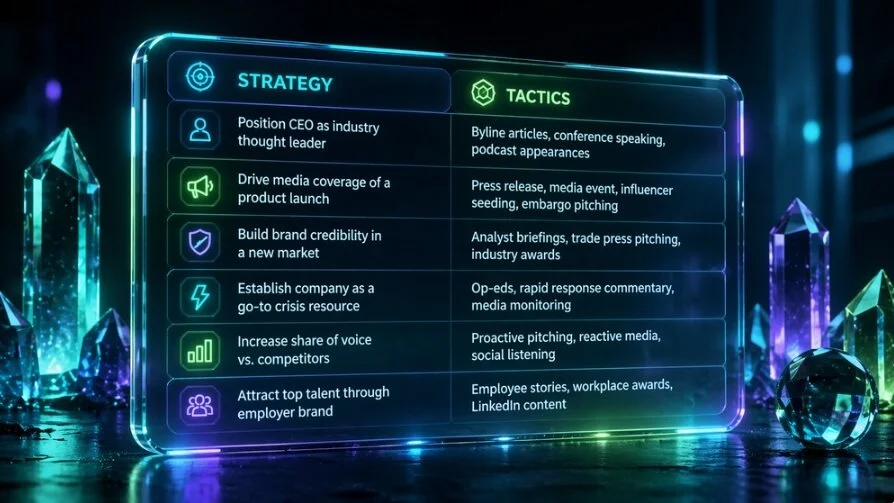
The simplest way to separate the two: strategy is what you want to achieve and why, while tactics are the specific actions you take to execute the strategy. A tactic without a strategy is just noise. A strategy without tactics is just a document. Both have to work together, but the strategy always comes first.
Why the Distinction Matters
When PR teams skip the strategy layer and go straight to tactics, two things happen. First, effort gets scattered across channels and initiatives that do not reinforce each other. Second, it becomes impossible to measure whether PR is actually working, because there was no defined outcome to measure against.
Strategic PR requires discipline upfront. It means asking "why are we doing this?" before asking "what are we doing?" That question, applied consistently, is what separates PR programs that build something durable from programs that generate coverage but not results.
The Three Pillars of PR: Owned, Paid, and Earned Media
Understanding and leveraging the three main components of PR, owned, paid, and earned media, is fundamental to creating a broad and effective PR strategy.
Owned Media
Owned media refers to content that is owned and controlled by your company: your website, blog posts, social media accounts, and email lists. Creating compelling content for these platforms helps you connect directly with your audience and build trust over time.
Maintaining the currency and relevance of your owned media is essential. Regularly updating your website, blog, and social channels with fresh, relevant content builds trust and drives a higher return on investment for your PR efforts.
Paid Media
Paid media involves advertising and sponsored content to reach target audiences and increase brand visibility. This includes pay-per-click advertising, sponsored posts, paid influencer partnerships, social media ads, and short-form video promotions.
In 2026, the most effective paid media channels for PR include short-form video, influencer marketing, first-party data targeting, and local audience campaigns. By investing in the right paid channels, you can extend your brand's reach to the right audience at the right time.
Earned Media
Earned media is publicity gained through media coverage, positive reviews, and word-of-mouth, without payment. It is the most credible form of PR because it comes from third parties who have chosen to cover or recommend your brand.
The advantages of earned media are significant. It enhances brand trustworthiness, improves SEO through backlinks and brand mentions, provides third-party validation that converts skeptical audiences, and builds thought leadership positioning in your category. Acquiring coverage from high-readership publications or industry influencers significantly improves your domain authority and drives qualified prospects to discover your brand.
How to Build a Strategic PR Plan: A Practitioner's Framework
A PR strategy without a repeatable framework is just a list of tactics. The framework below gives practitioners a structured process to move from audit to execution, with clear outputs at each stage.
Step 1: Situation Analysis & Audit
Before setting any goals, you need an honest picture of where you stand. Start by auditing your media coverage history, including volume, sentiment, tier of outlets, and share of voice. Then look at competitor messaging to identify which narratives they are owning and where the gaps are. Map out stakeholder perceptions by understanding how customers, investors, and employees currently talk about your brand. Finally, review your owned media performance across website traffic, content engagement, and social reach.
Use media monitoring platforms like Muck Rack or Mention, along with social listening tools and competitor coverage analysis, to pull this data.
The output of this step should be a PR-specific SWOT analysis that identifies communication strengths, weaknesses, opportunities, and threats, separate from your broader marketing SWOT.
Step 2: Goal Setting (SMART PR Goals)
PR goals are not marketing goals. Marketing goals focus on conversion. PR goals focus on perception, reputation, and visibility, and they should connect directly to business outcomes. Revenue-linked PR goals typically fall into three buckets: pipeline support (PR that drives inbound interest from target accounts), brand awareness (share of voice growth in your category), and thought leadership (positioning executives as credible voices in the industry).
Example SMART PR goals:
"Increase tier-1 media placements by 40% in Q2"
"Achieve 3 speaking slots at industry conferences by Q3"
"Grow share of voice from 12% to 20% in the cybersecurity category by year-end"
For more examples of well-structured PR goals, see our guide to PR objectives examples.
Each goal should have a clear owner, a timeline, and a metric attached to it before your plan moves forward.
Step 3: Audience & Stakeholder Mapping
Not all audiences need the same message, and not all audiences carry the same weight for your business. Your primary audiences to map include customers (existing and prospective), investors and analysts, media and journalists, industry analysts and influencers, and employees and prospective hires.
For each audience, document what they read and where they consume information, who they follow and trust, what messaging has resonated historically, and what business outcome this audience influences. A stakeholder priority matrix that ranks audiences by influence and engagement level helps you allocate resources and tailor outreach rather than spray messaging indiscriminately.
Step 4: Message Architecture
Your message architecture is the foundation every piece of PR content should be built on. It starts with your core narrative, which is the single company story that explains what you do, why it matters, and why now. This should be one to two sentences, and every spokesperson should be able to deliver it consistently.
From there, develop three to five key messages per primary audience segment. These are not taglines; they are specific, substantiated claims that address what each audience cares about. For every key message, identify the data, case studies, and third-party validation that back it up. A message without proof is a claim. A claim without proof is a liability.
Before deploying, test messages with internal stakeholders and, where possible, with actual members of your target audience. What sounds compelling internally often lands differently externally.
Step 5: Tactical Plan & Channel Mix
Once your goals, audiences, and messages are set, select the tactics that give you the best path to each goal. Every tactic should map to a specific objective, not just "build awareness."
For media relations, options include press releases for announcements with genuine news value, proactive pitching to journalists covering your beat, press tours and media briefings for major milestones, and reactive media for breaking news and trending topics.
Content and thought leadership tactics include bylines and op-eds placed in trade and business publications, long-form blog content targeting search-intent queries, and executive LinkedIn content that builds individual authority.
On the digital side, plan social media tied to campaign moments rather than just broadcast, an SEO-informed content strategy using your owned media, and an online newsroom with accessible assets for journalists. Event tactics include industry conference speaking and sponsorships, awards programs that validate third-party credibility, and owned events for direct stakeholder engagement.
For a deeper look at top PR tactics and types of PR campaigns that drive results, see our dedicated guides. Map each tactic to the specific goal it supports. If you cannot draw a direct line between a tactic and a goal, cut it.
Step 6: Measurement & KPI Framework
Measurement is not a post-campaign activity. Build your reporting structure before the plan launches.
Your media metrics should track placements by tier (tier-1, trade, regional), reach and impressions, share of voice vs. competitors, sentiment (positive, neutral, negative), and message pull-through, which tells you whether your key messages are actually appearing in coverage.
Business metrics should include web traffic from PR-driven coverage (tracked via UTM parameters and referral data), lead attribution from PR touchpoints, speaking invitations received, and inbound media inquiries.
Build your reporting cadence on three levels: weekly reporting on pitching activity, coverage log, and social monitoring; monthly reporting on KPI progress, share of voice updates, and campaign performance; and quarterly reviews against SMART goals with strategy adjustments.
For a deeper breakdown of which KPIs matter most by PR objective, see our guide to PR KPIs to track.
PR Tactics: A Complete Guide by Category
Selecting the right PR tactic depends on your goal, your timeline, and your resources. The categories below cover the full range of tactics available to PR practitioners, with guidance on when to deploy each one and how to know if it worked.
Media Relations Tactics
Press Releases
A press release is a formal written announcement distributed to journalists and media outlets. Use one for product launches, executive appointments, funding announcements, major partnerships, research releases, or any development with genuine news value. Do not issue a press release unless you have actual news.
The expected timeline runs two to three weeks from draft to distribution, including internal approvals and wire scheduling. Measure success through pickup rate, tier of coverage, inbound journalist inquiries generated, and referral traffic from coverage.
For example, Airbnb's announcement offering free housing to 100,000 Ukrainian refugees in 2022 generated widespread tier-1 pickup because the news itself was substantive.
For guidance on timing, see our guide to the best time to send a press release.
Media Pitching
A media pitch is a targeted, personalized outreach to a specific journalist proposing a story idea relevant to their beat. Use it when you have a story angle that is not strong enough for a broad press release, or when you want to place an exclusive with a single outlet before going wide. It's also effective for trend-driven stories, data drops, and thought leadership angles.
Pitching is ongoing work. Individual pitches should be sent one to two weeks before your ideal publication date. For features or long-form placements, allow four to six weeks. Success looks like reply rate, interview conversion rate, placements secured, tier of outlet, and message pull-through in published coverage.
Data-driven pitches with a specific angle tied to a journalist's recent coverage consistently outperform generic outreach. A cybersecurity company releasing breach data timed to coincide with a relevant news cycle will get more traction than the same data pitched cold three weeks later.
Press Tours
A press tour is a structured series of back-to-back briefings with journalists, analysts, or editors, usually conducted in person or virtually around a major announcement. Use it for major product launches, executive transitions, company rebrands, or market expansions where you need sustained media attention over a short window.
Plan six to eight weeks out. Schedule briefings two to three weeks in advance. Embargo coverage to publish simultaneously on launch day. Measure success through number of briefings completed, resulting coverage volume, outlet tier, and whether coverage ran on or near the target date.
Technology companies routinely conduct virtual press tours ahead of major product announcements, briefing editors at tier-1 outlets under embargo to ensure coordinated coverage drops on launch day.
Editorial Calendars
Editorial calendar work is the proactive identification of themed editorial opportunities at target publications and planning pitches to align with them. This is year-round planning. Most publications release editorial calendars in Q4 for the following year. Use them to identify issues, special reports, or theme months where your expertise is directly relevant.
Submit pitches eight to twelve weeks before a publication's themed issue date. Measure success through placements in themed issues, inclusion in special reports, and invitations to contribute to roundups or expert panels.
A financial services firm that pitches a byline to a business publication's annual "CEO Outlook" issue in October will face far less competition than one pitching a generic story in January.
Embargo Strategies
An embargo means sharing news with journalists in advance of a public announcement, under an agreement not to publish until a specified date and time. Use it when you want coordinated, simultaneous coverage from multiple outlets. It's best suited for major announcements where a single "moment" of coverage matters more than speed.
Embargo briefings typically happen 48 to 72 hours before lift time for news stories, and up to two weeks out for features or long-form pieces. Success means whether the embargo was honored, the number of outlets that published on lift, and the quality and tier of coverage.
Consumer product launches frequently use embargoes to coordinate coverage across tech, lifestyle, and business press, ensuring the announcement feels like a news event rather than a trickle of individual stories.
Exclusive Offers
An exclusive offers a single journalist or outlet the first right to cover a story in exchange for guaranteed placement. Use it when your story is strong enough to attract serious interest from a top-tier outlet but not broad enough to sustain coverage from multiple publications. It's also effective for sensitive announcements where message control matters.
Negotiate the exclusive one to two weeks before your target publish date. Have a backup plan if the outlet passes. Measure success through the tier and reach of the outlet that ran the exclusive, secondary pickup after the exclusive publishes, and inbound interest from other journalists following the placement.
A startup announcing a Series B round might offer an exclusive to a single business publication in exchange for a feature story, rather than distributing broadly and receiving only brief mentions.
Content Tactics
Thought Leadership Articles
Thought leadership articles are original, perspective-driven content published under an executive's byline in trade or business publications. Use them when building executive profile, entering a new market, or establishing credibility on a specific topic. They are most effective when tied to a genuine point of view, not a product pitch.
Expect four to six weeks from pitch to publication at most outlets. Some publications have queues of eight to twelve weeks. Measure success through publication tier, social shares and engagement, inbound speaking invitations, and journalist outreach triggered by the article.
An executive who publishes a data-backed op-ed in a major trade publication ahead of conference season will have a stronger speaking submission than one with no visible published perspective.
Bylines and Op-Eds
Bylines and op-eds are similar to thought leadership articles but typically more opinionated and tied to a specific news moment or industry debate. Use them when your executive has a strong, defensible position on a topic currently in the news cycle. Op-eds require a genuine argument, not a neutral overview.
Fast-turnaround op-eds tied to breaking news should be submitted within 24 to 48 hours of the triggering event. Planned op-eds follow the same four to six week timeline as bylines. Success looks like placement rate, reader engagement, social sharing, and follow-up media requests.
When a major regulatory decision affects an industry, the executives who have published op-eds staking out a clear position are the ones journalists call for reaction quotes.
Case Studies
Case studies are documented accounts of client or customer success stories that demonstrate real-world results. Use them for sales support, award submissions, media background materials, and conference speaking abstracts. Case studies are most effective when they include specific, verifiable metrics.
Plan three to four weeks to research, write, and gain client approval. Measure success through usage in sales conversations, inclusion in media pitches that result in coverage, and downloads from owned channels.
A B2B software company that documents a customer's measurable cost savings has a far more compelling media hook than one that describes the product's features in general terms.
Whitepapers and Research Reports
Whitepapers and research reports are long-form, data-driven documents that establish expertise and generate media coverage when distributed as news. Use them when you have proprietary data, original research, or a complex argument that requires depth. A whitepaper released as a PR asset needs an executive summary and a clear news hook to generate coverage.
Plan six to twelve weeks to research, write, design, and prepare distribution materials. Success metrics include media pickups, downloads, backlinks generated, and inbound speaking and interview requests.
Annual industry reports released by research firms, technology companies, and consulting firms consistently generate significant earned media because they provide journalists with original data they cannot get elsewhere.
Infographics
Infographics are visual representations of data or processes designed to be shared across media and social channels. Use them when you have data that tells a clear story but would be difficult to communicate in text alone. Infographics are effective as pitch supplements and social media assets.
Plan two to three weeks to design once data and copy are finalized. Measure success through social shares, media embed rate, and backlinks generated from publishers who use the asset.
A healthcare company releasing survey data as an infographic gives journalists a ready-made visual asset, which increases the likelihood of the data being included in a story.
Event Tactics
Media Events and Press Conferences
Media events and press conferences are structured gatherings designed to deliver news directly to journalists in a controlled setting. Use them for major announcements that benefit from in-person demonstration, executive access, or simultaneous Q&A. Press conferences are most justified when the news is significant enough to pull journalists away from their desks.
Plan four to six weeks out. Send save-the-dates three weeks in advance. Confirm attendance one week before. Measure success through journalist attendance, resulting coverage volume and tier, quality of Q&A exchange, and any follow-up interview requests.
Product launches with a physical demonstration component like automotive reveals and consumer electronics announcements consistently justify a media event because the hands-on experience produces richer coverage than a press release alone.
Launch Events
Launch events combine media access with consumer or partner engagement. Use them when a product or brand launch has enough visual and experiential value to generate social content and media coverage simultaneously.
Plan eight to twelve weeks for a mid-size event. Success metrics include attendee and press count, social media impressions from event content, resulting media placements, and post-event website traffic. Consumer brands frequently host launch events that double as content production opportunities, generating both media coverage and social assets from a single activation.
Conference Speaking
Conference speaking means securing speaking slots at industry conferences to build executive visibility and generate media opportunities. This is a year-round effort, but submissions typically open three to six months before a conference. Speaking is most effective when the topic is specific and data-driven rather than generic.
Submit abstracts three to six months in advance. Prepare materials four to six weeks before the event. Measure success through sessions secured, audience size, media coverage generated from the speaking slot, and inbound connections and follow-up requests.
Executives who speak at major industry conferences with a data-backed presentation frequently receive follow-up media requests from journalists who attended the session or saw coverage of it.
Awards Submissions
Awards submissions mean entering company, product, or executive nominations for industry and business awards programs. Use them when you have a documented achievement, measurable outcome, or recognized program worth validating through third-party endorsement. Awards are most valuable when the program is recognized by your target audience.
Research relevant awards in Q4 for the following year. Most programs have submission windows of four to eight weeks. Measure success through win rate, PR value of the award announcement, and usage of "award-winning" positioning in subsequent media pitches.
A company that wins a recognized industry award has a concrete, third-party validated news hook that is straightforward to pitch to trade press.
Digital Tactics
SEO-Optimized Online Newsroom
Your online newsroom is a dedicated section of your website housing press releases, media assets, executive bios, and brand resources. It should be live and maintained at all times. Journalists who cannot quickly find your press materials will move on.
The initial build requires four to six weeks. Ongoing maintenance is continuous. Measure success through journalist visits, asset downloads, inbound media inquiry form submissions, and newsroom pages indexed and ranking in search.
Companies with well-maintained newsrooms that include downloadable images, current executive bios, and recent press releases significantly reduce friction in the journalist-to-story pipeline.
Social Media Campaigns
Social media campaigns are coordinated social media activity designed to amplify a PR campaign, announcement, or earned media moment. Use them in support of any major campaign, announcement, or coverage moment. Social amplification should be planned before a campaign launches, not improvised after coverage lands.
Plan content two to three weeks ahead. Schedule posts to run in coordination with news release timing. Measure success through reach, engagement rate, referral traffic from social to coverage or owned content, and share of voice shift during the campaign window.
A company that plans its social content calendar around a product launch in advance can turn a single press placement into days of owned content that extends the story's reach.
Email Newsletters
Email newsletters are direct distribution of company news, thought leadership, and media coverage to a curated subscriber list. They are most effective as a consistent communication cadence, not a one-off announcement vehicle.
Allow one to two weeks to build a template and content process. Plan content on a monthly or bi-weekly cadence. Measure success through open rate, click-through rate, subscriber growth, and inbound responses from key stakeholders.
B2B companies that distribute a monthly newsletter featuring their earned media coverage keep their brand visible to investors, customers, and prospects between major announcement cycles.
Influencer Partnerships
Influencer partnerships mean collaborating with individuals who have established audiences relevant to your target market. Use them when your target audience follows specific voices more closely than they follow traditional media. They are most effective when the influencer has genuine relevance to your category, not just a large follower count.
Identify and vet partners four to six weeks before campaign launch. Contract and content approval adds two to three weeks. Measure success through reach, engagement, referral traffic, conversion from influencer-specific tracking links, and sentiment of audience response.
Rihanna's Fenty promotion during the 2023 Super Bowl halftime show generated an 833% increase in brand searches, demonstrating how influencer visibility at the right moment can produce measurable business impact.
Crisis Tactics
Holding Statements
A holding statement is a brief, factual statement issued immediately when a crisis breaks, before full information is available. Use one within the first hour of any crisis situation. A holding statement buys time, demonstrates awareness, and prevents a "no comment" from becoming the story.
It should be drafted and approved within 30 to 60 minutes of a crisis breaking. Success looks like whether the statement was picked up accurately, whether it held the narrative while the full response was prepared, and how many follow-up inquiries it contained.
Companies that issue a factual holding statement immediately, acknowledging the situation and committing to provide more information, consistently receive less hostile initial coverage than those that go silent.
Media Monitoring
Media monitoring is the continuous tracking of coverage, social mentions, and competitor activity across all relevant channels. Keep it running at all times, with increased intensity during campaigns, crises, and major announcements.
Set up monitoring before any campaign launches. Real-time alerts should be active at all times. Measure success through speed of identifying coverage and mentions, accuracy of sentiment tracking, and the number of actionable opportunities or threats identified before they escalated.
A company with active media monitoring that identifies a negative story within minutes of publication has significantly more response options than one that discovers the story hours later through a client call.
Rapid Response Protocol
A rapid response protocol is a pre-approved process and messaging framework that allows PR teams to respond to breaking news quickly and consistently. Build the protocol before you need it. Rapid response is most effective when decision trees, approval chains, and message templates are already in place.
Protocol development takes two to three weeks. Activation, when needed, should happen within one to two hours of a triggering event. Success means response time, accuracy and consistency of messaging across spokespeople and channels, and media coverage sentiment following the response.
Organizations that have pre-approved statement templates for common crisis scenarios like data breaches, executive departures, and product recalls can issue accurate, on-brand responses in the time it takes competitors to schedule an internal meeting.
PR Campaign Planning Timeline: 12 Weeks from Strategy to Results
Most PR campaigns underperform because they are planned too late. Journalists operate on lead times. Content takes longer to produce than expected. Media lists need vetting. A 12-week planning window gives you enough runway to front-load the work that determines whether a campaign lands or gets ignored.
The 12-Week Framework
Weeks 1–2: Research Pull your media coverage history. Audit competitor messaging. Build your initial media list and verify contacts are current. Do not skip this step — a media list built on stale data will cost you more time during outreach than it saved you here.
Weeks 3–4: Strategy Finalize your goals, audience priorities, and message architecture. Test key messages with internal stakeholders before any external exposure. Lock your campaign narrative and get sign-off before content development begins.
Weeks 5–7: Content Development Write and edit all campaign assets: press release, pitch angles, supporting data, spokesperson quotes, and any multimedia. Front-load asset creation here so outreach is not delayed by last-minute approvals or rewrites.
Weeks 8–10: Outreach Begin pitching. Tier your outreach — lead with your highest-priority targets first, so you have time to follow up and pivot angles if early response is weak. Track every contact, response, and coverage hit in real time.
Weeks 11–12: Measurement Compile coverage, pull traffic and referral data, calculate share of voice movement, and document what worked and what did not. This debrief becomes the starting point for your next campaign.
Seasonal Planning: When to Pitch What
Certain story types have predictable windows. Plan around them rather than reacting to them.
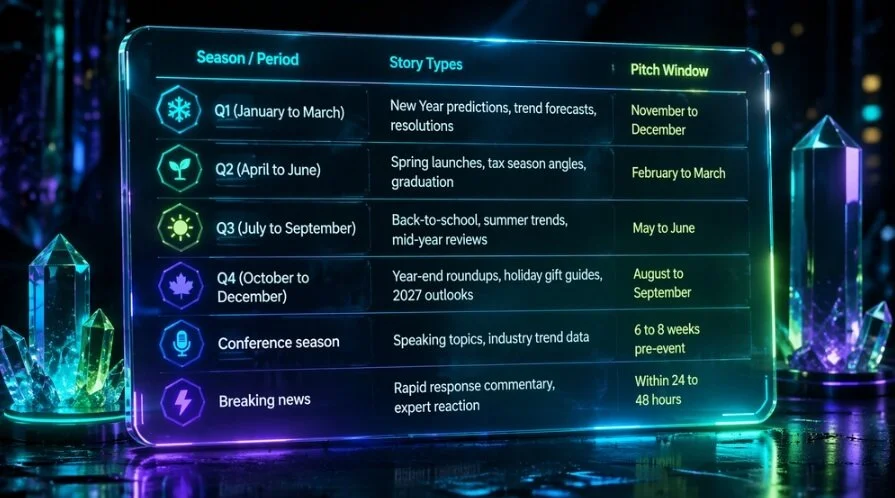
Seasonal pitching is not about forcing your story into a calendar hook. It is about knowing when editors are actively looking for specific story types and having your materials ready before that window opens.
Social Media PR Planning: Turning Platforms Into PR Tools
Social media and PR are not the same function, but they should operate from the same playbook. When they do not, earned media gets underutilized, messaging drifts, and opportunities to amplify coverage disappear.
Amplifying Earned Media
When coverage lands, social media is how you extend its reach beyond the outlet's existing audience. Share press hits across owned channels with direct links, tag the journalist and publication where appropriate, and repurpose key quotes or data points from the coverage into standalone posts. Coverage that gets amplified performs better for SEO, drives more referral traffic, and signals to other journalists that your brand generates interest.
Social Listening for PR Opportunities
Social listening is one of the most underused tools in PR planning. Monitoring trending topics, breaking news, and competitor conversations in real time surfaces newsjacking opportunities before they close. Set up keyword alerts for your industry, your competitors, and the specific beats your target journalists cover. When a relevant story breaks, a well-timed pitch built on that momentum will outperform a cold outreach every time.
Platform-Specific PR Tactics
Not every platform serves the same PR purpose. Match your effort to where each audience actually lives.
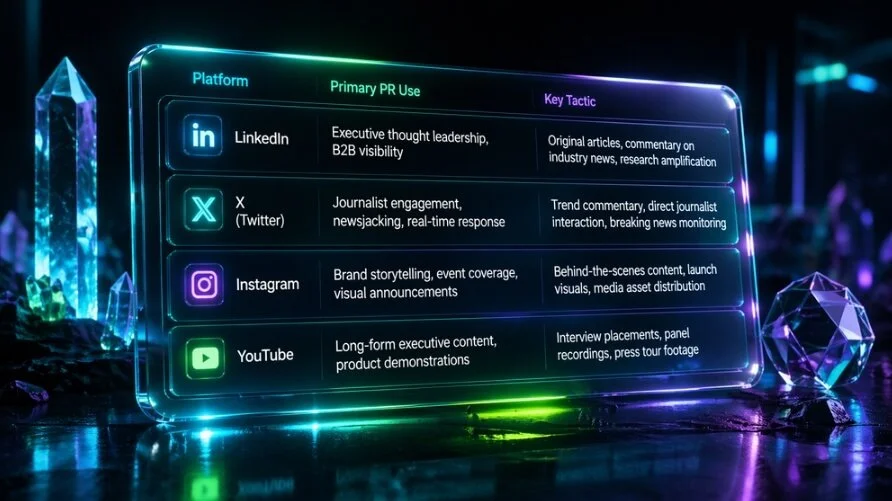
Journalist engagement on X is still relevant, but it requires consistency. Executives who comment on industry news regularly, not just when they have something to promote, build the kind of familiarity that makes a cold pitch feel warm.
Measuring the Success of Your PR Strategy
Evaluating the success of your PR strategy is critical for monitoring progress, gauging impact, and making data-driven decisions. The metrics below align directly with the goals set in Step 2 of the framework.
Key PR Metrics
The metrics that matter most for evaluating a PR program include sent and replied pitches, opened and clicked emails, media coverage volume and tier, brand mentions, and social media engagement. On the business side, track website traffic from PR-driven coverage, Media Quality Score (MQS), Share of Voice (SOV), pitch success rate, and message pull-through in coverage. Used together, these metrics tell you not just how much coverage you generated, but whether that coverage actually moved the needle for your brand.
PR Measurement Tools
Google Analytics / GA4: Track newsroom traffic, referral traffic from coverage, and UTM-tagged campaign links
Muck Rack: Media monitoring, journalist database, and coverage reporting
Mention: Real-time brand and competitor monitoring across web and social
Ahrefs: Domain authority tracking, backlink monitoring, and content performance
Google Alerts: Free, lightweight brand and keyword monitoring with email notifications
Presspage: Newsroom performance and press release traffic measurement
By using these tools alongside your KPI framework from Step 6, you can measure whether PR is driving business outcomes — not just generating coverage.
PR Strategy Examples: 3 Frameworks You Can Model
The following examples break down how a complete PR strategy works in practice, from goal through tactics to measurable results. Each one is built around a different business situation.
Example 1: Tech Startup Launch Strategy
Business situation: Series A company entering a crowded market with no existing media presence.
Goal: Generate brand awareness and establish market credibility within 90 days of launch.
Strategy: Position the company as a category creator rather than a competitor. Instead of fighting for coverage in a crowded space, define a new category the company can own. Every piece of outreach leads with the problem the category solves, not the product itself.
Tactics: The launch strategy centers on an exclusive launch story placed with TechCrunch, offered under embargo to a single journalist with strong startup coverage. This runs alongside a CEO byline in Forbes making the category argument in the executive's own voice. The plan also includes three conference keynote submissions to industry events in the six months following launch, plus a press kit with proprietary data supporting the category narrative.
Results framework: Target 15 media placements in the first 90 days, reaching a combined audience of 100,000 or more across placements. Use inbound journalist inquiries as a signal that the narrative is gaining traction, and track speaking slots secured as third-party validation of executive authority.
What makes it work: The exclusive gives the launch a single moment of high-impact coverage rather than diluted pickup across multiple outlets. The byline extends the narrative beyond the news cycle. The conference strategy builds visibility over the medium term.
Example 2: Crisis Recovery Strategy
Business situation: Mid-size company facing media scrutiny following a confirmed data breach affecting customer records.
Goal: Rebuild trust with customers, media, and stakeholders within 60 days of the incident.
Strategy: Transparent, proactive communication at every stage. Get ahead of the story rather than responding to it. Every communication prioritizes what customers need to know over what the company wants to say.
Tactics: The response begins with a CEO holding statement issued within 60 minutes of breach confirmation, acknowledging the situation and committing to a full update within 24 hours. Direct customer notification goes out before any media outreach, so customers do not learn about the breach from a news story. A media briefing follows with the CEO and head of security providing a factual account of what happened, what data was affected, and what remediation steps are underway. Throughout, social media monitoring runs on real-time alerts to identify and respond to emerging narratives before they escalate, and weekly stakeholder updates continue for 30 days to demonstrate ongoing accountability.
Results framework: Track response time from breach confirmation to public statement, sentiment shift in coverage from initial incident reporting to 30-day follow-up, customer retention rate in the 90 days following the breach, and volume of follow-up negative coverage relative to initial incident coverage.
What makes it work: Speed and transparency in the first 24 hours determine how the story gets framed. Companies that get ahead of a crisis with factual, accountable communication consistently receive less sustained negative coverage than those that go quiet. For a deeper breakdown of crisis communication tactics, see our guide to crisis PR management.
Example 3: B2B Thought Leadership Strategy
Business situation: Established B2B company with strong customer retention but low brand visibility among prospects and industry analysts.
Goal: Position the company as the go-to authority in its category over a 12-month period.
Strategy: Build a multi-channel thought leadership program anchored in original research, so every piece of content and every media pitch leads with data the company owns. Instead of seeking coverage for what the company does, seek coverage for what the company knows.
Tactics: The program runs on quarterly research reports on industry trends, distributed as PR assets with accompanying media pitches. Analyst briefings with the top five firms covering the category are scheduled around each research release. A speaking circuit targets four to six major industry conferences per year, with session topics drawn directly from research findings. A LinkedIn content program for two to three executives publishes weekly, amplifying research data and reacting to industry news. Byline placement in two trade publications per quarter rounds out the mix, authored by subject matter experts rather than executives alone.
Results framework: Track share of voice growth in trade press over 12 months, analyst mentions in published reports as a signal of growing authority, speaking slots secured per quarter, inbound media inquiries generated by research releases, and LinkedIn follower and engagement growth for participating executives.
What makes it work: Proprietary research gives the program a renewable content engine. Every quarter, the new report resets the news cycle and gives the media team a fresh, data-backed pitch. The analyst briefing strategy builds the behind-the-scenes credibility that influences how the company gets positioned in third-party research, which then reinforces the media narrative.
Want to see what a PR strategy looks like for your industry? Request a sample PR plan.
Adapting Your PR Strategy to Industry Trends
Keeping pace with industry trends is vital to maintaining a competitive edge in PR. The evolving relationship between digital PR and SEO highlights the increasing interdependence between these two areas. Digital PR brings tangible benefits including brand building, backlinks, and brand mentions, all of which positively affect your SEO and organic visibility.
Emerging trends like AI-assisted media monitoring, influencer marketing, and short-form video offer new avenues for PR professionals to explore. By staying informed and adapting your strategy to these shifts, you can capitalize on new opportunities and drive stronger results for your brand.
Summary
A strategic PR plan is the difference between communications that build something durable and activity that generates coverage without results. The framework in this post — situation analysis, goal setting, audience mapping, message architecture, tactical planning, and measurement — gives you a repeatable process for any campaign or program type.
Start with the audit, set goals tied to business outcomes, and select tactics that map directly to those goals. Measure everything. Adjust based on what the data tells you.
Frequently Asked Questions
What is a PR strategy? A PR strategy is a structured plan that uses media, content, and communications to achieve defined business outcomes — including building brand awareness, managing reputation, and driving stakeholder engagement.
How do you create a PR plan? Start with a situation audit, set SMART goals tied to business objectives, map your key audiences, build your message architecture, select tactics that align with your goals, and establish a measurement framework before the plan launches.
What is the difference between PR strategy and PR tactics? Strategy is what you want to achieve and why. Tactics are the specific actions you take to execute the strategy. A media pitch is a tactic. Positioning your CEO as a category authority is a strategy.
What should a PR strategy framework include? A complete PR strategy framework includes a situation analysis, SMART goal setting, audience and stakeholder mapping, message architecture, a tactical plan with channel mix, and a KPI measurement framework.
How do you measure PR success? Measure PR success through a combination of media metrics (placements, share of voice, sentiment, message pull-through) and business metrics (web traffic from PR coverage, lead attribution, inbound media inquiries, speaking invitations). Build the measurement framework before the plan launches, not after.